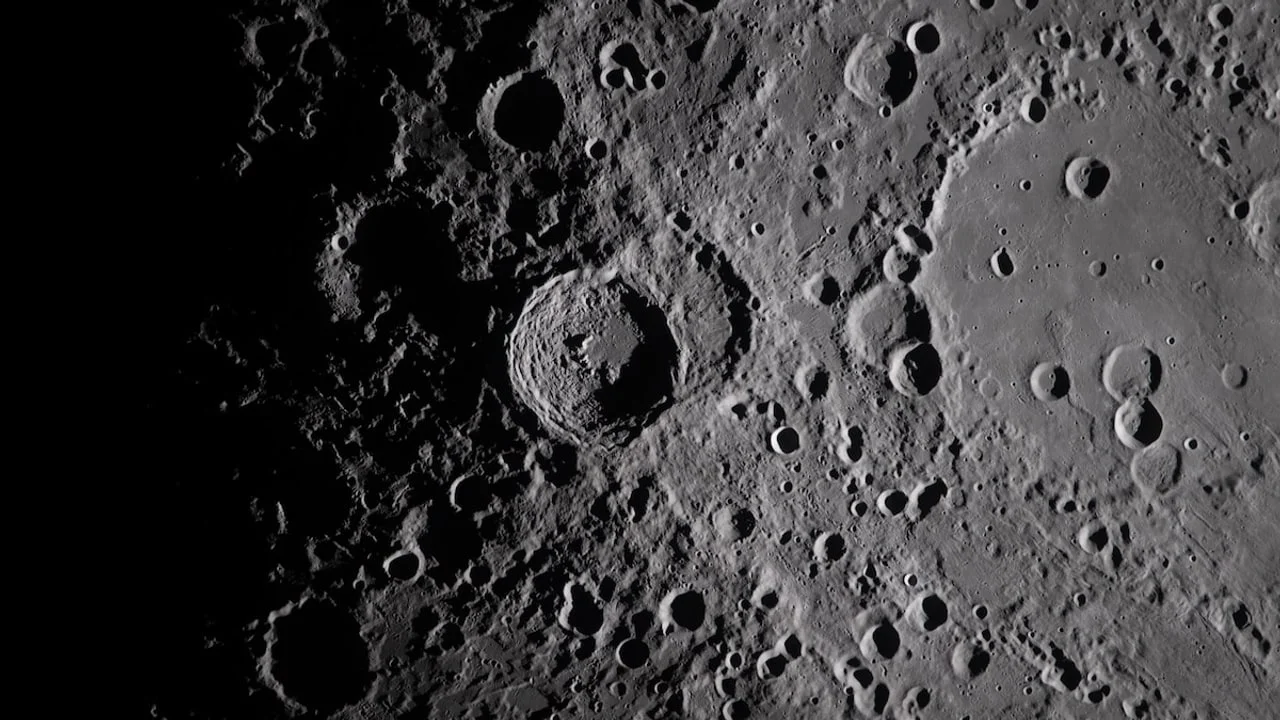
月球背面有个「耳朵」,专门用来聆听宇宙诞生时的沉默
宇宙大爆炸约 38 万年后,有一段无星无光的「宇宙黑暗时代」。NASA 团队正设计一座月球背面射电望远镜(LCRT),用折纸工艺展开的自主机器人,把陨石坑变成天线盘,聆听那段来自洪荒时代的氢气低语。今年先导实验机 LuSEE-Night 将率先登陆测试可行性。本期附完整中英对照译文、10 个核心词汇及两段长难句语法拆解。

How a telescope on the far side of the moon could help us see the cosmic dark ages 来源:National Geographic|作者:Robin George Andrews(英国伦敦,科学记者)|发布日期:2026 年 6 月 3 日宇宙大爆炸后 38 万年,有一段没有星光、没有星系的「宇宙黑暗时代」。那里曾飘荡着中性氢气发出的无线电波——极其微弱,却能告诉我们宇宙的基本物理法则是否正确。问题是:地球本身就是一口永不停歇的「电磁噪声锅」,根本听不见。NASA 的工程师们把目光投向了月球背面:那里静得出奇,还有现成的陨石坑可以当天线盘。今年,一台先导实验机将率先降落。如果一切顺利,人类将首次「打开宇宙的一扇新窗户」。
一、原文与参考译文
Part 1
Millions of years ago, an asteroid crashed into the far side of the moon, the hemisphere always facing away from Earth. In the coming years, a robot might land in the crater it left behind and build a radio telescope fit for the future of astronomy.That's the premise behind an ambitious project called the Lunar Crater Radio Telescope, or LCRT, that aims to turn a moon crater into a telescope using self-assembling robots. The moon blocks out noisy radio interference from Earth, and its far side is littered with craters that could serve as a telescope dish. This makes it an ideal spot to listen for faint radio waves coming from the so-called cosmic dark ages—a mysterious epoch sandwiched between the big bang and the birth of the very first stars.
译文
数百万年前,一颗小行星撞上了月球背面——那半个始终背对地球的月球。未来几年,一台机器人可能就会落进那道撞击留下的陨石坑,在里面建起一座面向未来天文学的射电望远镜。
这就是「月球陨石坑射电望远镜」(LCRT)的构想核心:用自主组装机器人,把一座陨石坑变成一面天线。月球本身可以屏蔽来自地球的电磁干扰,而月球背面密布着大量坑穴,天然具备抛物面天线的地形。这让它成了聆听「宇宙黑暗时代」微弱无线电波的理想位置——所谓黑暗时代,是一段夹在宇宙大爆炸与第一批恒星诞生之间、神秘而幽暗的宇宙早期纪元。
Part 2
Being able to hear those ancient radio waves will allow scientists to probe the very nature of reality. "We would know whether our physics is correct, or whether we need to build new physics," says Saptarshi Bandyopadhyay, a robotics technologist at NASA's Jet Propulsion Laboratory in California, and the lead researcher on the LCRT project."It opens a new window on the universe—and we don't have many windows left," says Michael Garrett, an astronomer and the director of the Jodrell Bank Centre for Astrophysics in England. "This is the big one."
译文
一旦能够捕捉到那些来自洪荒时代的无线电波,科学家就能探测现实世界最根本的本质。「我们将知道,我们现有的物理学是否正确——或者,我们是否需要重建一套新的物理学,」NASA 喷气推进实验室机器人技术专家、LCRT 项目首席研究员萨普塔尔希·班达约帕迪亚如此说道。1
「这打开了宇宙的一扇新窗——而我们能打开的窗户已经不多了,」英国乔德雷尔班克天体物理学中心主任、天文学家迈克尔·加勒特说,「这扇是最大的那扇。」1
Part 3
From exploding stars to planetary auroras, pretty much everything that produces energy in the cosmos emits radio waves—the same type of wave that your car radio converts into sound. Unlike visible light, these waves are invisible and inaudible to humans. Unfortunately, for astronomers wanting to hear all this, Earth acts like a thundering loud megaphone: Not only does its ionosphere—the electrified layer of the planet's upper atmosphere—make quite the racket, but all our technology can't stop beaming out artificial radio waves."It's a horrendous amount of noise," says Anže Slosar, a researcher at Brookhaven National Laboratory in New York. If you're an astronomer hoping to perceive the far-flung cosmos, "it's like looking upward from the bottom of a swimming pool." And there isn't much scientists can do from Earth. "The only way to escape it is to hide from it," he says.Thankfully, there's a great hiding spot just 240,000 miles away. "For radio astronomy, the moon is one of the best places," says Garrett. If you're on the lunar far side, you're facing away from Earth, and the moon acts as a giant geologic barrier to the planet's cacophony. And if you take measurements at night, it also filters out the sun's own radio interference.
译文
从爆炸的恒星到行星极光,宇宙中几乎所有能量来源都会发射无线电波——就是你车载收音机接收的那种波。这些波人眼看不见、耳朵听不到。糟糕的是,对于想要聆听宇宙的天文学家而言,地球本身就像一只震耳欲聋的扩音器:电离层(大气层顶端那层带电气体)吵个不停,我们的各种技术设备也在没完没了地辐射人工无线电波。
「噪声大得可怕,」布鲁克海文国家实验室研究员安日·斯洛萨尔说。对于想要感知遥远宇宙的天文学家,「这就像趴在游泳池底部仰头看天。」而在地球上,科学家几乎无计可施:「唯一的出路,就是躲开它。」1
好在 38.4 万公里外有个绝佳的藏身处。「对于射电天文学,月球是最好的选址之一,」加勒特说。站在月球背面,背对着地球,月球本身就是一道巨大的地质屏障,把地球的喧嚣挡得一干二净。如果在月夜进行观测,太阳自身的电磁干扰也会被一并过滤。
Part 4
Any radio astronomy conducted on the moon would be welcome. But detecting a signal from "the cosmic dark ages is the long-term goal," says Slosar. Around 380,000 years after the Big Bang, the universe was a soup of neutral hydrogen gas. That hydrogen would eventually clump together and ignite as the first stars, but back then, there was nothing but darkness.But raw hydrogen emanates radio waves of a very specific wavelength. This distant signal would be extremely weak, but if scientists could tune into it, they could find out how ordinary matter interacted with enigmatic dark matter—an as-yet undetected 'glue' that binds the universe together—to shape the cosmos we live in today.There's no guarantee that a telescope on the lunar far side will be able to hear anything: Even with Earth and the sun blocked out, the hum of the Milky Way galaxy itself is still far louder than those hydrogen whispers. But if it does detect those murmurs, our understanding of the universe will change forever. "It's totally uncharted territory," says Garrett.
译文
在月球上开展任何射电天文观测都值得庆贺,但探测「宇宙黑暗时代」的信号才是终极目标,斯洛萨尔说。宇宙大爆炸约 38 万年后,宇宙还是一锅中性氢气的浓汤。这些氢气最终会聚集坍缩,点燃第一批恒星的火焰——但在那之前,茫茫宇宙中只有黑暗。1
而原始氢气会以一种非常特定的波长发射无线电波。这个来自远古的信号极其微弱,但如果科学家能「调到那个频道」,便可以揭开普通物质与神秘暗物质(那个将宇宙捏合在一起、迄今尚未被直接探测到的「胶水」)之间的互动方式——正是这种互动,塑造了我们今天所在的宇宙。
当然,没人能保证月球背面的望远镜一定能听到什么:即使屏蔽了地球和太阳,银河系本身的低鸣声依然比那些氢气低语响亮得多。但一旦真的探测到了那些喃喃细语,人类对宇宙的理解将永远改变。「这完全是未知领土,」加勒特说。
Part 5
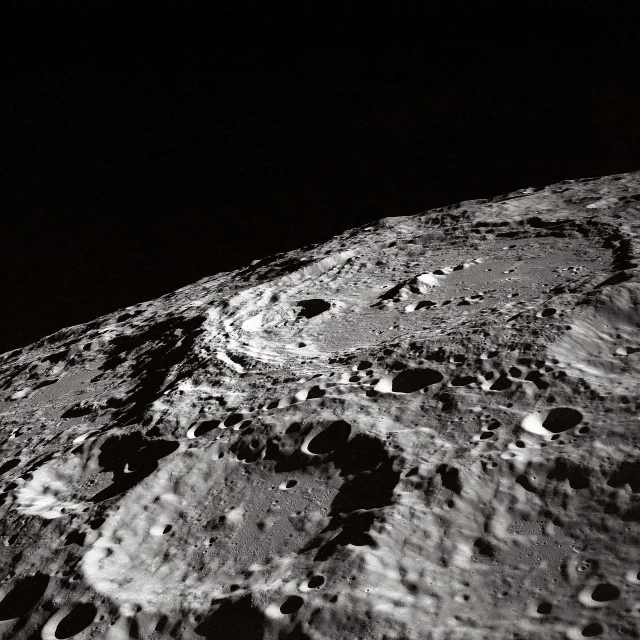
Scientists have put forward a range of lunar radio telescope ideas. The final form will need to be large enough to "hear" those far-flung radio signals—something the LCRT offers by taking advantage of the moon's chasm-covered topography.The task of building the telescope would be left to a family of robots: A lander would deliver a concave mesh material made of wires and adorned with reflecting panels to the center of one of the moon's many impact craters. These panels would bounce radio waves from the sky into a receiver that's hanging above the crater floor. Several additional rovers would hoist the wires up to the crater rim and pull them tight, elevating both the mesh and receiver. The crater would shield the telescope from any radio waves not coming from the sky, including any solar radio waves that have managed to skip along the lunar surface.
译文
科学家们提出了各种月球射电望远镜方案,但最终形态必须足够大,才能「听见」那些来自宇宙深处的无线电波——而 LCRT 的聪明之处,正在于充分利用月球布满深坑的地形。
望远镜的建造工作全部交给一支机器人团队:一台着陆器先将一张由金属丝构成的凹形网状结构运送到某座陨石坑中央,网上铺有反射板。这些反射板将把天空传来的无线电波反射进悬挂在坑底上方的接收器。另外几辆漫游车负责将金属丝拉到坑口边缘并绷紧,将整个网面与接收器一同升起。陨石坑的坑壁则充当天然屏蔽,挡住所有非来自天空方向的无线电波——包括那些沿月球表面掠过的太阳电磁波。
Part 6
Bandyopadhyay had some concerns. Relying on several robots to accomplish this task means that, should one malfunction, the telescope would be incomplete. It would also be a somewhat slow process, one that could take the robots through several dangerous night-day cycles that might kill them off.Bandyopadhyay shared revised designs for the telescope with National Geographic. The LCRT team has reduced its fleet of robots to just one. A solitary droid would land in the middle of a large impact crater—one 4,300 feet across, sufficiently sizable to give the LCRT its expansive form but also not too large to hinder self-assembly—and fire out anchored cables in multiple directions. When their anchors are attached to the crater rim, motors will make them taut, lifting a radio receiver above the lander in the process.During this deployment, a 1,150-foot-long radio wave reflector designed to concentrate the radio waves coming from the sky onto the receiver will unfurl like a star-shaped flower in bloom. "We took some ideas from origami," says Bandyopadhyay.
译文
然而班达约帕迪亚有些担忧。依赖多台机器人协同意味着,一旦其中一台故障,望远镜就无法完成。整个过程也相对缓慢,可能让机器人经历几个危险的昼夜交替循环而损毁。
为此,他向《国家地理》分享了修订后的设计方案:将机器人团队精简至只剩一台。这台孤独的机器人降落在一座直径约 1300 米的陨石坑中央——坑径够大,足以支撑 LCRT 的展开规模,同时又不至于大到妨碍自主组装——然后向四面八方射出带锚的缆绳。当锚点固定在坑缘,电机将缆绳拉紧,把无线电接收器悬吊在着陆器正上方。1
随着缆绳展开,一张长约 350 米的无线电波反射器像一朵星形花徐徐绽放,将天空传来的无线电波汇聚到接收器上。「我们从折纸艺术中借鉴了一些想法,」班达约帕迪亚说。
Part 7(先导实验:LuSEE-Night)
First, scientists need to demonstrate that radio astronomy is possible on the moon. That's the purpose of the upcoming Lunar Surface Electromagnetics Experiment-Night, or LuSEE-Night experiment, a collaboration between NASA, the Department of Energy's Brookhaven National Laboratory, and the University of California, Berkeley."No U.S. mission has landed on the far side of the moon. No private company has landed on the far side of the moon," says Slosar. And nobody has listened to cosmic radio signals on the lunar far side.The biggest menace will be the lunar environment. There is a small risk of a bullet-like micrometeorite fatally wounding the robot. And "the temperature swings are horrendously large," says Slosar, going from hundreds of degrees above zero to hundreds below zero from lunar day to lunar night. LuSEE-Night is equipped with radiators and internal heating mechanisms to try to keep it from freezing or sweltering."If we can survive the first night, we can survive many," says Slosar. LuSEE-Night is scheduled to hitch a ride to the moon aboard Firefly Aerospace's commercial lander later this year.
译文
在 LCRT 正式上马之前,科学家需要先证明一件事:在月球上进行射电天文观测是可行的。这正是今年将发射的先导实验「月球表面电磁实验-夜间」(LuSEE-Night)的使命——它由 NASA、布鲁克海文国家实验室和加州大学伯克利分校联合研发。
「迄今没有任何美国任务登陆过月球背面,没有任何私人公司登陆过月球背面,」斯洛萨尔说。更别说在月球背面聆听宇宙无线电信号了。1
最大的威胁来自月球环境本身:微陨石像子弹一样,随时可能击毁机器人;「温差极其剧烈,」斯洛萨尔说——月球白天和黑夜之间,温差可以超过几百摄氏度。LuSEE-Night 搭载了散热片和内部加热装置,竭力在冻与烤之间寻求平衡。
「只要熬过第一个月夜,就能熬过很多个,」斯洛萨尔说。今年晚些时候,LuSEE-Night 将搭乘 Firefly Aerospace 的商业着陆器飞往月球。1
二、核心词汇
阅读原文,把这些词汇放回具体语境:
コンテンツカードを読み込んでいます…
| 词汇 / 短语 | 音标 | 词性 | 中文释义 | 语境说明 |
|---|---|---|---|---|
| cosmic dark ages | /ˈkɒzmɪk dɑːk ˈeɪdʒɪz/ | n. phr. | 宇宙黑暗时代 | 指宇宙大爆炸约 38 万年后至第一批恒星点亮之间的时期,中性氢气弥漫,无任何光源 |
| radio telescope | /ˈreɪdiəʊ ˈtelɪskəʊp/ | n. phr. | 射电望远镜 | 不接收可见光,专门探测无线电波的天文望远镜 |
| ionosphere | /aɪˈɒnəsfɪə(r)/ | n. | 电离层 | 地球大气层顶端带电气体层,会对无线电波产生强烈干扰 |
| neutral hydrogen | /ˈnjuːtrəl ˈhaɪdrədʒən/ | n. phr. | 中性氢 | 未被电离的氢原子,宇宙黑暗时代的主要物质成分,会发射特定波长无线电波 |
| dark matter | /dɑːk ˈmætər/ | n. phr. | 暗物质 | 宇宙中大量存在但尚未被直接探测到的神秘物质,通过引力将物质结构维系在一起 |
| cacophony | /kəˈkɒfəni/ | n. | 刺耳噪音,嘈杂声 | 文中比喻地球产生的大量电磁干扰,"the planet's cacophony" |
| micrometeorite | /ˌmaɪkrəʊˈmiːtiəraɪt/ | n. | 微陨石 | 极小的流星体碎片,速度极快,对月球表面仪器构成威胁 |
| self-assembling | /self əˈsemblɪŋ/ | adj. | 自主组装的 | 描述 LCRT 机器人能在无人遥控的情况下独立完成望远镜的搭建 |
| chasm | /ˈkæzəm/ | n. | 深渊,裂缝 | 文中泛指月球表面的深坑地形("chasm-covered topography") |
| origami | /ˌɒrɪˈɡɑːmi/ | n. | 折纸(艺术) | 日本折纸工艺,LCRT 反射器的展开设计从中借鉴了折叠与展开的力学原理 |
三、长难句语法拆解
句子一
原句:The moon blocks out noisy radio interference from Earth, and its far side is littered with craters that could serve as a telescope dish, making it an ideal spot to listen for faint radio waves coming from the so-called cosmic dark ages—a mysterious epoch sandwiched between the big bang and the birth of the very first stars.
主干分析(SVO)
本句由 and 连接两个并列分句:
- 分句一:The moon blocks out noisy radio interference from Earth.
- 主语:The moon
- 谓语:blocks out(屏蔽)
- 宾语:noisy radio interference from Earth
- 分句二:its far side is littered with craters that could serve as a telescope dish, making it an ideal spot...
- 主语:its far side(月球背面)
- 谓语:is littered with(遍布着)
- 宾语:craters(陨石坑)
- 定语从句:
that could serve as a telescope dish— 修饰 craters,说明这些坑可以充当天线盘 - 现在分词短语:
making it an ideal spot to listen for...— 作结果状语,说明「因此使它成为…的理想位置」 - 不定式:
to listen for faint radio waves— 修饰 spot - 后置定语(分词短语):
coming from the so-called cosmic dark ages— 修饰 radio waves - 破折号后的同位语:
a mysterious epoch sandwiched between the big bang and the birth of the very first stars— 解释说明 cosmic dark ages
语法要点:①
litter 常用被动式 be littered with,表「散落着/遍布着」;② 现在分词 making... 作结果状语,是英语高频语法,相当于 so that it becomes...;③ 破折号后的同位语是地道英文句式,用来补充解释前文名词。句子二
原句:If scientists could tune into it, they could find out how ordinary matter interacted with enigmatic dark matter—an as-yet undetected 'glue' that binds the universe together—to shape the cosmos we live in today.
主干分析(SVO)
- 条件状语从句:
If scientists could tune into it(虚拟语气,表假设) - 主句:they could find out [how ordinary matter interacted with dark matter ...]
- 主语:they
- 谓语:could find out
- 宾语:
how ordinary matter interacted with ... dark matter— 宾语从句,作 find out 的直接宾语- 宾语从句内:ordinary matter(普通物质)与 enigmatic dark matter(神秘暗物质)发生 interacted with
- 破折号内的同位语:
an as-yet undetected 'glue' that binds the universe together— 解释 dark matteras-yet是复合形容词,意为「迄今为止尚未…」- 定语从句:
that binds the universe together— 修饰 glue
- 不定式短语:
to shape the cosmos we live in today— 作目的/结果状语- 关系代词省略的定语从句:
we live in today— 修饰 cosmos(原为the cosmos (that) we live in today)
- 关系代词省略的定语从句:
语法要点:① 虚拟语气
could + 动词原形,表「如果能的话,就能…」;② as-yet 是英语中常见复合前置修饰语,相当于 not yet;③ 关系代词省略的定语从句在英语中极为普遍,需要读者自动补全。
このコンテンツについて、さらに観点や背景を補足しましょう。