June 6 in Business History: Four Decisions That Rewrote the Rules
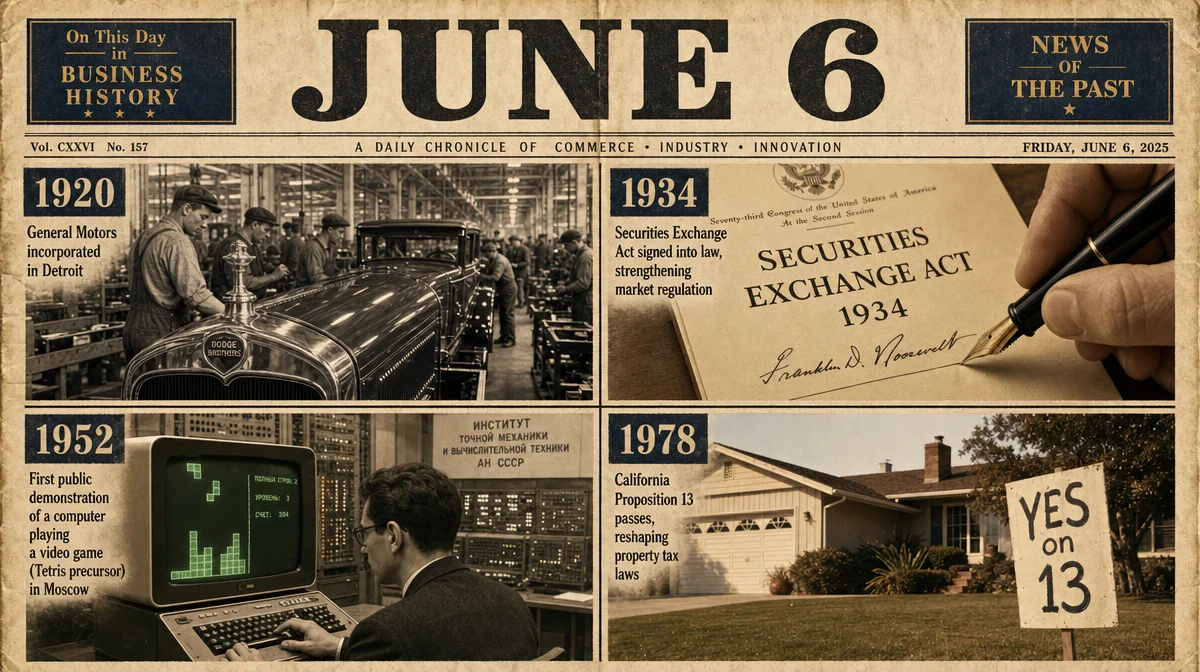
On June 6 across four decades, four decisions permanently reshaped American business: Walter Chrysler built a third U.S. automaker from a bankrupt rival in 1925 — only for each subsequent rescue to cost a piece of its independence. FDR signed the Securities Exchange Act in 1934, appointing Wall Street's wiliest insider as the first SEC chair. Alexey Pajitnov created Tetris in a Soviet lab in 1984 and watched others collect the royalties for twelve years. And California voters cut property taxes 57% in 1978, triggering a national tax revolt whose structural consequences still govern schools and housing today.
Four decisions landed on June 6 across a span of 59 years. One was a corporate reorganization in a Detroit suburb. One was a presidential signature at noon. One was a programmer playing around on a Soviet text terminal. One was a ballot measure that 64.79% of California voters approved against the explicit opposition of the governor, the legislature, every union, and virtually every newspaper in the state. None of the people making these decisions could have predicted the structures they were building — or, in one case, the structures they were escaping.
1925: Birth of a third automaker
Walter Chrysler was 49 years old and had already been fired once, walked away once, and made his first fortune twice. 1 He started as a railroad machinist in Kansas, rose to run the Buick division under William C. Durant at a salary of $10,000 per month plus $500,000 in annual bonuses, 2 and then walked out in 1919 when he couldn't reconcile his vision of the business with Durant's. He sold his General Motors stock back to Durant for $10 million, 1 then spent two years turning around Willys-Overland for $1 million a year before acquiring control of the struggling Maxwell Motor Company in 1921.
Maxwell was a cautionary tale: once America's third-largest carmaker, it had over-expanded after World War I and couldn't sell more than half its output. 3 Chrysler fixed the cars first — what dealers called the "Good Maxwell" — then used the surviving manufacturing platform to launch a car under his own name. The Chrysler Six, introduced in January 1924, came with full-pressure lubrication, an oil filter, four-wheel hydraulic brakes, and a high-compression engine, all at a price that undercut what competitors charged for far less sophisticated vehicles. 4 The car sold immediately and in volume.
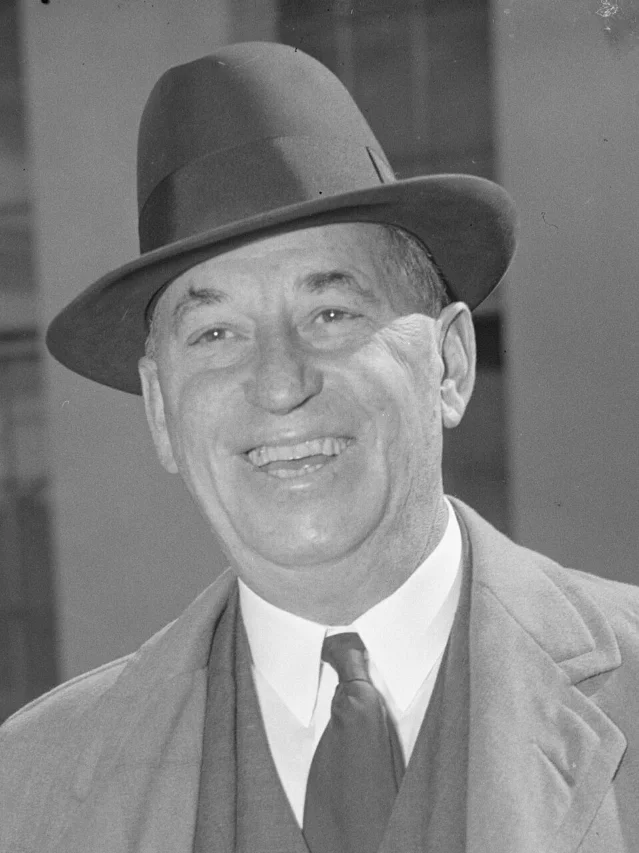
On June 6, 1925, he formally reorganized Maxwell Motor Company into Chrysler Corporation, taking the chairman and president roles himself. 3 Three years later, he bought Dodge Brothers from the investment bank Dillon, Read & Co. for $170 million — a company with $119 million in assets acquired by a company with roughly $90 million. 5 The same day he launched Plymouth (low-end) and DeSoto (mid-range), copying GM's brand-ladder strategy. By 1936, Chrysler had risen to second in U.S. sales, behind only General Motors. 4
The full arc of what Chrysler built runs 96 years and ends with absorption. In 1979, Lee Iacocca (Chrysler's CEO after Henry Ford II fired him from Ford in 1978) went to Congress to request a federal loan guarantee. Congress provided $1.5 billion in guarantees, 6 and the government received stock warrants as security. Chrysler paid back the entire loan seven years ahead of schedule in 1983; the U.S. government netted approximately $500 million on the warrants. 4 The K-car and the minivan saved the company. Then, in 1998, Daimler-Benz acquired Chrysler in a deal worth $35 billion, calling it a "merger of equals." 7 It was not. In 2000, Daimler CEO Jürgen Schrempp admitted to a German newspaper that Chrysler had been designed from the start as a subsidiary. Chrysler lost €2.2 billion in 2001. In 2007, Daimler sold 80.1% of Chrysler to the private equity firm Cerberus Capital Management for €5.5 billion ($7.4 billion) — one-fifth of what it had paid nine years earlier. 7 Chrysler filed for Chapter 11 in April 2009. The U.S. government invested a total of $12.5 billion through TARP and recovered $11.2 billion — a net loss to taxpayers of $1.3 billion. 8 In January 2021, Chrysler's parent merged with PSA Group to form Stellantis, and Chrysler as an independent company ceased to exist. 4
Mirror: Chrysler was rescued three times — by Walter Chrysler in 1921, by Congress in 1979, and by Fiat in 2009. Each rescue worked. Each one also cost the company a piece of its independence. The pattern suggests a practical question for any executive facing a rescue: what does the capital cost in control, not just in interest? Iacocca's answer in 1979 was government warrants — a recoverable cost. The DaimlerChrysler answer was nominally zero — and cost everything. The structure of the deal matters more than the headline.
1934: The watchdog America built in a crisis
By the time FDR signed the Securities Exchange Act at noon on June 6, 1934, 9 the financial infrastructure of the United States had been through five years of demolition. The Dow Jones Industrial Average had dropped from 381 in September 1929 to 41 by July 1932 — an 89% decline. 10 Approximately 11,000 of the nation's 25,000 banks had failed. Margin loans had expanded from roughly $1 billion annually in the early 1920s to approximately $6 billion by 1928, as investors bought stocks on 10% down. 10
The Senate's Pecora Commission — named for Ferdinand Pecora, the Sicilian-born New York assistant district attorney who became its chief counsel in January 1933 — spent two years exposing the machinery behind the collapse. Charles Mitchell, chairman of National City Bank (today's Citigroup), had sold 1.3 million shares of Anaconda Copper to depositors at approximately $120 per share; the stock eventually fell to roughly $5. 11 Mitchell also sold National City Bank shares to his wife in 1929 specifically to avoid a tax liability, leading to his arrest for tax evasion. J.P. Morgan Jr. testified under oath that he and several partners had paid no income taxes in 1931 and 1932. 11 Edgar Brown, a former theater-chain owner, described to Pecora how National City Bank salespeople had refused to let him sell his portfolio when he tried to exit in October 1929. Asked what he recovered, Brown answered: "Not a cent." 10
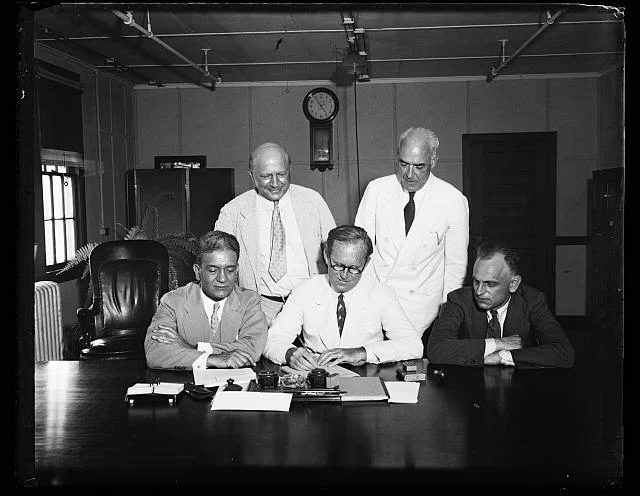
Pecora's 1939 memoir Wall Street Under Oath summarized the core failure: "Legal chicanery and pitch darkness were the banker's stoutest allies." 11 The Act FDR signed on June 6 was designed as a permanent light source: mandatory registration of exchanges, periodic public reporting (the precursor to the 10-K and 10-Q), the sweeping anti-fraud language of Section 10(b), and the creation of the Securities and Exchange Commission in Section 4. 12 At the signing, FDR asked Pecora: "Ferd, now that I have signed this bill and it has become law, what kind of law will it be?" Pecora replied: "It will be a good or bad bill, Mr. President, depending upon the men who administer it." 9
FDR then named Joseph P. Kennedy Sr. as the SEC's first chairman — a man who had made his fortune through the very practices the Commission was created to stop. The reported rationale: "It takes a thief to catch a thief." 13 New Deal liberal Jerome Frank likened the appointment to "setting a wolf to guard a flock of sheep." 13 Kennedy served 431 days. His approach was "friendly enforcement" — conferences with exchange officials and brokers, proving that markets functioned better regulated than unregulated. Kennedy recruited William O. Douglas and Abe Fortas, both later Supreme Court justices. 13
The pattern held for 91 years: every major expansion of the SEC followed a crisis. The Enron and WorldCom accounting frauds produced Sarbanes-Oxley in 2002. The 2008 financial collapse produced Dodd-Frank in 2010. The SEC model — mandatory disclosure, an independent agency, civil enforcement with DOJ criminal referral authority — has been adopted by securities regulators in over 100 countries. 14 In FY2024, the SEC obtained $8.2 billion in financial remedies, the highest in agency history. 15
Mirror: The "Kennedy paradox" — appointing the most experienced practitioner of an industry's worst practices as its chief regulator — remains one of the most contested ideas in regulatory design. The argument for: deep knowledge of evasion patterns, credibility with the regulated industry, faster ramp-up. The argument against: conflicted loyalties, regulatory capture, public legitimacy deficit. Companies building internal compliance functions face the same tradeoff whenever they hire from the industries they're policing. Kennedy's 431-day record suggests the approach can work — but only if the mandate is specific and the time horizon is bounded.
1984: The Soviet game that escaped its creator
On June 6, 1984, Alexey Pajitnov, a 29-year-old speech recognition researcher at the Dorodnitsyn Computing Center of the Soviet Academy of Sciences in Moscow, finished building a game on the Elektronika 60 — a Soviet clone of the PDP-11 that had no graphical interface. 16 He used spaces, brackets, and text characters to represent falling shapes inspired by the pentomino puzzles he bought in Moscow toy stores. He reduced the twelve five-square shapes to seven four-square shapes (tetrominoes) to keep the game manageable. He called it Tetris — the Greek "tetra" (four) combined with "tennis," his favorite sport. 17
Pajitnov told CNN: "I couldn't stop myself from playing this prototype version, because it was very addictive to put the shapes together." 17 Under Soviet copyright law, he had no right to profit from the game — it belonged to the state. He assigned the rights to the Computing Center for ten years. Within months, floppy copies spread through Moscow computer circles. By 1986, a copy had reached Hungary.
What followed was a licensing war across four countries. Robert Stein of Andromeda Software found Tetris in Hungary, misread a noncommittal Soviet telex response as consent, and began selling rights he didn't own. He sold computer rights to Mirrorsoft (UK, owned by media tycoon Robert Maxwell) and Spectrum HoloByte (US) for £3,000 plus royalties. 18 Both companies released Tetris commercially in January 1988 to immediate success. The rights chain then subdivided further: Mirrorsoft sublicensed console rights to Atari Games (Tengen), which sublicensed Japanese arcade rights to Sega. Nobody had cleared any of this with the Soviet state monopoly ELORG, which held all actual rights to Soviet software exports.
In February 1989, Dutch entrepreneur Henk Rogers, who ran a small Japanese game company called Bullet-Proof Software, flew to Moscow on a tourist visa and walked uninvited into ELORG's offices. He told The Guardian in 2025: "I was in a room with seven people, some of them KGB types, being given the third degree for a couple of hours, like: 'Who the hell are you coming into the Soviet Union?!'" 19 Pajitnov was in the room and warmed to Rogers when he realized Rogers was a game designer. One month later, Nintendo of America president Minoru Arakawa and VP Howard Lincoln flew secretly to Moscow and offered ELORG a $5 million guaranteed minimum royalty for exclusive worldwide handheld and console rights. The deal was signed March 22, 1989. 16
Rogers persuaded Arakawa to bundle Tetris with the Game Boy instead of Super Mario Land. His pitch: "If you want little boys to buy your Game Boy, include Mario. But if you want everyone to buy your Game Boy, then you should include Tetris." 17 The Game Boy launched in the U.S. on July 31, 1989, with Tetris in the box. The Game Boy version of Tetris sold 35 million copies as of June 2024. 16 Atari Games (Tengen) had launched its own NES version in May 1989; a U.S. federal judge granted Nintendo an injunction on June 22, 1989, and thousands of Atari cartridges were recalled. 16
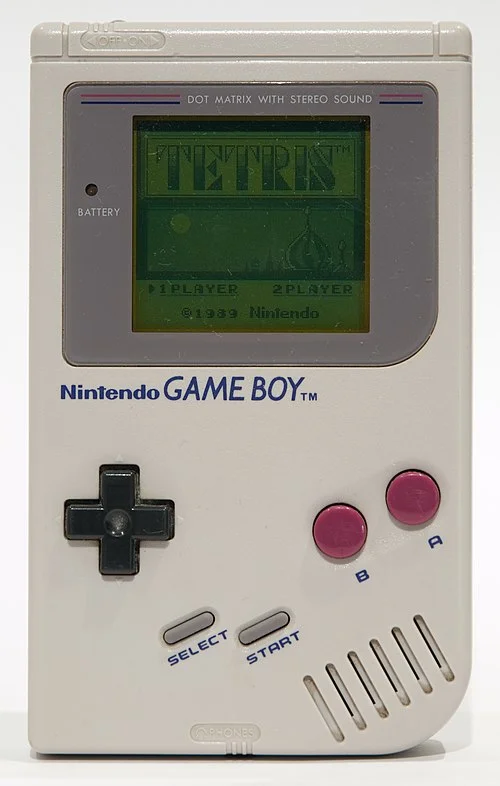
Pajitnov received zero royalties for approximately 12 years. The Computing Center's 10-year rights deal expired at the end of 1995; with Rogers' help, Pajitnov emigrated to Seattle in 1991 and later worked at Microsoft from 1996 to 2005. In 1996, they formed The Tetris Company as an equal partnership. As of December 2024, Tetris has sold over 520 million copies worldwide and holds Guinness records as the most-ported video game (70+ platforms) and the game with the most distinct official versions (approximately 220). 16
Mirror: Two structural decisions separated Pajitnov from the value he created for 12 years: IP ownership (state law eliminated his claim) and platform selection (Rogers secured the right platform, Game Boy, while every competitor fought over console rights). Neither factor was visible at the moment of creation in 1984. Today's equivalents are contractual IP assignment clauses in employment agreements and API platform dependency in software products. The Tetris case is not simply a story about Soviet bureaucracy; the same mechanism operates in any corporate structure where an employee's creation defaults to employer ownership without explicit negotiation.
1978: The ballot box that rewired California
On June 6, 1978, California voters approved Proposition 13 — formally the "People's Initiative to Limit Property Taxation" — by 4,280,689 votes (64.79%) to 2,326,167 (35.21%). 20 The measure capped property taxes at 1% of assessed value, rolled assessments back to 1975-76 levels, limited annual increases to 2% or the inflation rate (whichever was lower), and required a two-thirds supermajority for any future state or local tax increase. [cite:21|Ballotpedia: California Proposition 13 (June 1978)|[https://ballotpedia.org/California_Proposition_13,Tax_Limitations_Initiative(June_1978)]
Before the vote, California's average property tax rate was 2.67% of assessed value, according to the California Legislative Analyst's Office. 21 The inflation of the 1970s combined with annual market-value reassessments had created what critics called an "assessment spiral": homes purchased years earlier for modest prices were suddenly generating unaffordable tax bills for fixed-income homeowners. Howard Jarvis, a 75-year-old retired appliance manufacturer who had pushed tax reform in California for 16 years without success, co-sponsored the initiative with real estate agent Paul Gann. Their campaign collected 1.2 million signatures to qualify for the ballot — nearly triple the 449,846 required. 22 Governor Jerry Brown, the state legislature, every union, every major local government, and virtually every newspaper in the state opposed it.
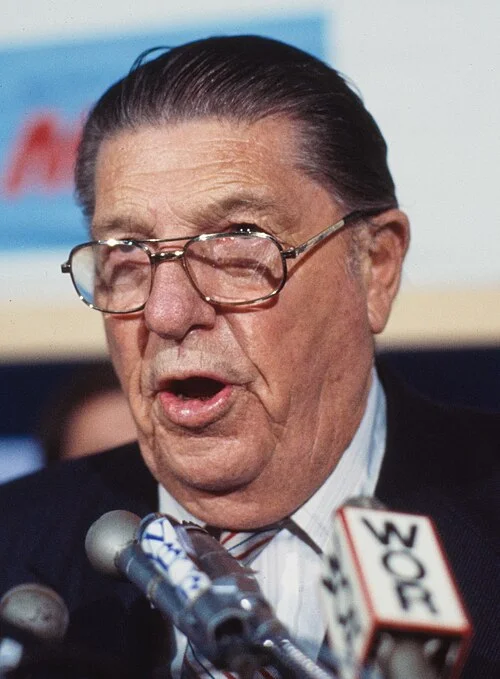
The immediate fiscal impact was severe: local government property tax revenues dropped approximately 60% in the first year, a loss the GAO estimated at roughly $7 billion in 1978-79 (approximately $34 billion in 2026 dollars). 21 The state used a $6 billion surplus to cushion the blow with block grants to local governments and assumed primary responsibility for K-12 school funding. Within two years, 43 states had implemented some form of property tax limitation or relief. 23 Massachusetts passed Proposition 2½ in 1980. Ronald Reagan had been Proposition 13's most prominent celebrity supporter, recording radio advertisements concluding: "Vote Yes on Proposition 13 — for the American Dream." 24 Reagan's 1980 presidential campaign economic advisor Martin Anderson later said the Prop 13 result made cutting taxes "no longer a theory." 24
The long-run consequences split along two lines that reformers in 1978 did not foresee. California's K-12 schools fell from 5th in per-student funding to 47th within two decades of the vote. 20 The state shifted from a primarily property-tax-funded system to one heavily dependent on income taxes, where the top 1% of earners now fund roughly half of state income tax receipts — making school budgets highly volatile in recessions. The California Legislature Analyst's Office found in 2016 that about two-thirds of Prop 13's ongoing tax relief went to households with incomes above $80,000. 21 The lock-in effect — homeowners have a powerful incentive to stay put rather than trigger reassessment — reduced Bay Area residential mobility by an estimated 28% (3 extra years) for long-time owners. 21 In 48 years, California voters have passed 24 of 33 proposed amendments to Proposition 13. The three core pillars — 1% cap, 2% annual limit, reassessment only on sale — have never been touched. 25
Mirror: Proposition 13 demonstrates the asymmetry between winning a ballot measure and controlling what it builds. Jarvis wanted to protect homeowners from tax-driven displacement. The measure did that — and also centralized California's finances in Sacramento, made the state's budget more volatile, restructured school funding for generations, and created a commercial property reassessment loophole that the California Board of Equalization estimated in 2018 was worth up to $269 million per year to businesses that knew how to exploit it. Any organization designing a structural reform — whether a governance change, a compensation restructure, or a regulatory proposal — should map the second-order effects before the vote, not after.
Cover image: AI-generated editorial illustration.
참고 출처
- 1Wikipedia: Walter Chrysler
- 2Detroit Historical Society: Walter P. Chrysler
- 3Wikipedia: Maxwell Motor Company
- 4Wikipedia: History of Chrysler
- 5Automotive News: Chrysler buys the Dodge Brothers
- 6NPR: Examining Chrysler's 1979 Rescue
- 7The Guardian: From $35bn to $7.4bn in nine years
- 8Wikipedia: Chrysler Chapter 11 reorganization
- 9SEC Historical Society: 431 Days — Joseph P. Kennedy and the Creation of the SEC
- 10The Hustle: The banker who caused the 1929 stock crash
- 11Wikipedia: Pecora Commission
- 12Wikipedia: Securities Exchange Act of 1934
- 13SEC Historical Society: Building an Institution — The Chairman and First Principles
- 14Wikipedia: U.S. Securities and Exchange Commission
- 15SEC.gov: Enforcement Results for FY2024
- 16Wikipedia: Tetris
- 17CNN: Tetris: The Soviet 'mind game' that took over the world
- 18The Digital Antiquarian: A Tale of the Mirror World, Part 6
- 19The Guardian: Henk Rogers interview (2025)
- 20Wikipedia: 1978 California Proposition 13
- 21California Legislative Analyst's Office: Common Claims About Proposition 13 (2016)
- 22Wikipedia: Howard Jarvis
- 23Hoover Institution: The Tax Revolt Turns 20 (1998)
- 24Metropolitan News-Enterprise: Reagan Was Proposition 13 Supporter Number One (2004)
- 25CalMatters: Exploring the Prop. 13 Tax Revolt family tree (2020)
이 콘텐츠를 둘러싼 관점이나 맥락을 계속 보강해 보세요.