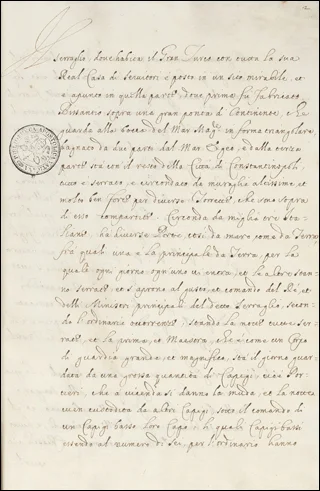
Inside the forbidden palace: a Venetian spy's manuscript, now at the Vatican
Vatican manuscript Ott.lat.2674, digitized June 2 2026, is a 17th-century Italian copy of Ottaviano Bon's Descrittione del Serraglio del Gran Turco — one of the most widely reproduced European accounts of life inside the Ottoman harem, based on the Venetian diplomat's clandestine visit to Topkapi Palace around 1587. The manuscript passed through the library of Queen Christina of Sweden before entering the Vatican's Ottoboniani latini collection in 1748. It is now freely viewable on DigiVatLib.

In the early 1600s, copies of a manuscript began circulating through Venice with the urgency of contraband. The text claimed to describe something no European was supposed to see: the inner quarters of Topkapi Palace — the harem, the kitchens, the dormitories, the ranks of servants and concubines — assembled from a clandestine visit arranged by a Venetian diplomat who had talked his way through doors that were otherwise shut to outsiders.
On June 2, 2026, one of those manuscript copies became publicly viewable for the first time, in the Vatican Apostolic Library's digital collection. 1
The manuscript and what it says
Ott.lat.2674 is a 17th-century Italian manuscript of 94 folios, held in the Vatican's Ottoboniani latini collection. Its title — Descrittione del Serraglio del Gran Turco, "A description of the Grand Turk's seraglio" — announces its subject plainly enough. 2 The opening line of folio 2r sets the scene in the same matter-of-fact tone: "Il Serraglio, doue habita il Gran Turco con tutta la sua Real Casa di Seruitori e posto in un site mirabile." ("The Seraglio, where the Grand Turk lives with all his Royal Household of Servants, is placed in a marvelous site.") 1
The text almost certainly copies — with minor variants — the Descrizione del serraglio del Gransignore written by the Venetian diplomat Ottaviano Bon (1552–1623). Bon served as Venice's bailo (resident ambassador) in Constantinople from 1604 to 1609, a posting that put him inside the Ottoman power structure at close range. The underlying account he drew on was a personal visit to the harem, arranged around 1587 through channels that the historical record does not fully explain. 3 4
Historians read Bon's account as something genuinely scarce. Eric R. Dursteler (professor of history at Brigham Young University) describes it as "a rare first-person description of the sultan's seraglio based on a surreptitious personal visit Bon arranged." 3
What Bon claimed to have seen
The Descrizione is organized as a bureaucratic survey of the palace compound — room by room, hierarchy by hierarchy. Bon covers the layout of the inner courts, the structure of the pages' school, the chain of command among the eunuchs, the arrangements governing the women's quarters, and the daily rhythms that nobody outside the walls was supposed to know about.
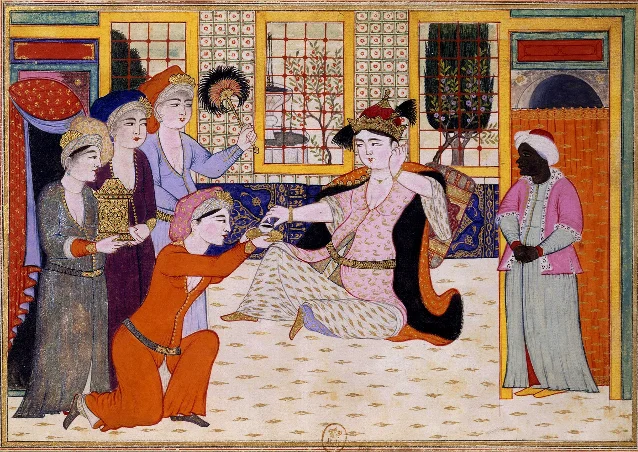
The passage on the women's dormitories became particularly famous in later decades, especially after Robert Withers translated Bon's Italian into English in 1625 for Samuel Purchas's Hakluytus Posthumus. Withers rendered the harem lodgings with the comparison that stuck in readers' minds: "Now in the Womens lodgings, they live just as the Nunnes doe in their great Monasteries; for, these Virgins have very large Roomes to live in, and their Bed-chambers will hold almost a hundred of them a piece." 4
Other passages attracted attention for different reasons. The observation that cucumbers and gourds entering the women's quarters "are sent in unto them sliced, to deprive them of the meanes of playing the wantons" 4 — a detail that modern scholars read as a projection of European anxieties onto Ottoman life — circulated across every subsequent European account of the harem for the next two centuries, whether or not the copying author acknowledged Bon's name.
From Venice to print to manuscript copies
Bon's original text first circulated in manuscript form around 1606 and was printed in Venice not long after. It spread widely enough to be translated into English by 1625 and issued as a standalone London publication in 1650. 3 5 The text circulated under several variant titles — Relazione del serraglio, Descrizione del serraglio — which is precisely why manuscript copies like Ott.lat.2674 can be identified even when the scribe did not credit Bon by name.
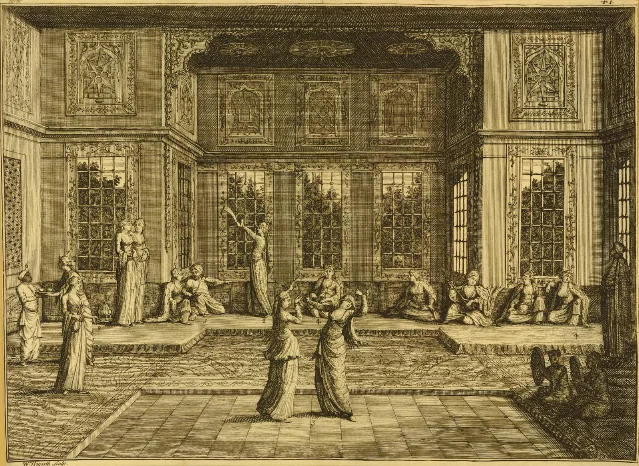
Scholars working on this tradition note that Bon stands out as arguably the last Western male author of a seraglio account whose description appears genuinely firsthand — rather than recycled from earlier texts. The Alpennia/LHMP project, which systematically traces the sources behind early European harem literature, identifies Bon as "the last of the male-authored accounts that appear to be solidly 'original.'" 4
The journey to the Vatican
Bon died in 1623. The copy now designated Ott.lat.2674 passed through one of the 17th century's most remarkable libraries before landing at the Vatican.
The manuscript belongs to the Ottoboniani latini series — a collection assembled by Cardinal Pietro Ottoboni (later Pope Alexander VIII) after he purchased the library of Queen Christina of Sweden (1626–1689) following her death in Rome. Christina had accumulated one of Europe's largest private libraries, partly through the spoils of Sweden's campaigns in the Thirty Years' War; the Ottoboni purchases added a trove of Italian manuscripts to holdings that had been built with Swedish military force. The Vatican purchased the entire Ottoboni collection in 1748. 6
The DigiVatLib metadata page for the manuscript cites Susanna Åkerman's Queen Christina of Sweden and her Circle (Brill, 1991), 6 which places this copy squarely within the scholarly literature on Christina's holdings. How it reached her collection — whether through diplomatic exchange, purchase, or the general dispersal of Italian manuscript culture across northern Europe — the record does not say.
Now open in DigiVatLib
Ott.lat.2674 joined DigiVatLib on June 2, 2026, as part of the library's Week 22 digitization batch of 90 manuscripts. 1 The IIIF manifest is not yet provisioned — a normal lag for freshly digitized Vatican codices — but the folio viewer is live and all 94 pages are accessible.
콘텐츠 카드를 불러오는 중…
The text Bon wrote has been available in print since 1625 and in modern scholarly edition since 2002. 3 What the Vatican's digitization makes visible is something different: the handwriting of an anonymous 17th-century scribe who thought the account worth copying out again, the circular library stamp that marks the manuscript's passage through Christina's collection, and the particular shape of a text that spread through early modern Europe in exactly this way — one careful copy at a time, carrying secrets that were never quite as secret as they seemed.
Cover image: folio 2r of Vatican manuscript Ott.lat.2674, © Biblioteca Apostolica Vaticana — free for personal and research use.
참고 출처
- 1Vatican Manuscripts Added Week 22 of 2026 — Wiglaf.org
- 2Ott.lat.2674 — DigiVatLib Edition/Browse Page
- 3Ottaviano Bon — Academia.edu / Brill (Eric R Dursteler)
- 4LHMP #413 Bon 1587 The Grand Signiors Serraglio — Alpennia
- 5A description of the Grand Signor's seraglio (1650) — Folger Shakespeare Library Catalog
- 6Ott.lat.2674 — DigiVatLib Detail Page
이 콘텐츠를 둘러싼 관점이나 맥락을 계속 보강해 보세요.