Stardew Valley — The Farming Sim That Sold 50 Million Copies by Doing Almost Nothing Right on Purpose
Today's pick: Stardew Valley (ConcernedApe, 2016). Metacritic 89 (PC/Xbox One), 87 (Switch), 86 (PS4); IGN 10/10 (2024 reassessment); Steam Overwhelmingly Positive (98% of 387,000+ reviews); Golden Joystick Breakthrough Award 2016; 50 million copies sold by February 2026. One developer — code, art, and music — over five years. This guide covers how the 28-day season loop, energy system, and five optional skill trees work, what players love and where the game genuinely tests patience (fishing minigame, info overload, the time-pressure anxiety the game was supposed to eliminate), and a spoiler-free setup for the corporate dropout inheriting a broken farm in a town quietly losing its soul.

Today's pick: Stardew Valley (ConcernedApe, 2016). Metacritic 89 (PC/Xbox One), 87 (Switch), 86 (PS4); IGN 10/10 (2024 reassessment); OpenCritic 99% critics recommend; Steam Overwhelmingly Positive (98% of 387,000+ reviews); Golden Joystick Breakthrough Award 2016; BAFTA Best Game nomination; 50 million copies sold by February 2026. One developer built the entire thing — code, art, music — over five years in his apartment. This guide covers how the season cycle, energy system, and five skill trees work (no single "correct" path, which is kind of the whole point), what players love about it and where it genuinely tests your patience, and a spoiler-free setup for the world you're dropped into.
| Developer | ConcernedApe (Eric Barone, solo) |
| Released | February 26, 2016 (PC); console/mobile ports through 2017–2019 |
| Platforms | PC, PS4, Xbox One, Switch, iOS, Android, Switch 2 |
| Genre | Farming sim / life RPG |
| Playtime | 50–100+ hours for a first playthrough; no real endpoint |
| Metacritic | 89 (PC/Xbox One) · 87 (Switch) · 86 (PS4) |
| IGN | 10/10 (2024 reassessment) 1 |
| Steam | Overwhelmingly Positive · 98% of 387,000+ reviews 2 |
How it plays
콘텐츠 카드를 불러오는 중…
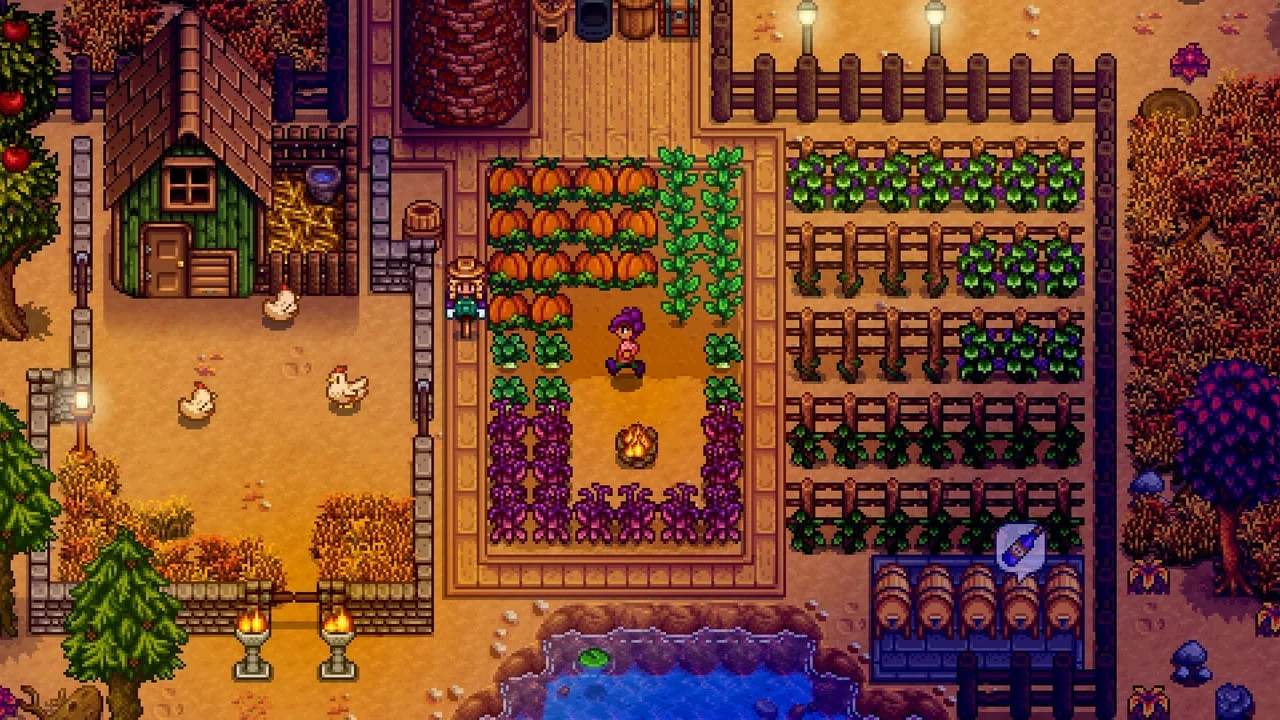
You start the game on a bus out of a corporate office. Your grandfather left you a farm in Stardew Valley. The farm is a wreck — weeds, rocks, fallen logs everywhere. You have a few hand-me-down tools, a small amount of money, and 26 days until the first growing season ends.
That framing is doing a lot of work. The game wants you to feel the pressure of time without actually punishing you for going slowly. Every in-game day runs roughly 14 minutes of real time before it ends at 2 a.m. and you pass out. Your energy bar limits how much you can chop, mine, and water before you need to stop.3 Those two mechanics — the clock and the energy bar — are the whole game. Everything else is what you do while managing them.
There are five skill trees you level by doing: Farming (planting, harvesting, animal care), Foraging (gathering wild plants), Fishing (a timing-based minigame with a wriggling progress bar), Mining (digging into the cave beneath the town), and Combat (fighting the monsters inside that cave). You don't have to develop all five. You don't have to develop any of them in a particular order. The game also has a Community Center — a dilapidated building in town filled with "bundle" slots. Completing a bundle requires you to donate specific items: certain crops, fish, minerals, artisan goods. Finishing a bundle unlocks something in the town. Finishing all the bundles in a room completes it. The Community Center is probably the closest the game has to a main quest.3
The year runs in four 28-day seasons — Spring, Summer, Fall, Winter. Different crops grow in different seasons, and they die if you don't harvest before the season turns. That seasonal reset is the game's main forcing function: it creates natural short-term goals without ever telling you what they are.
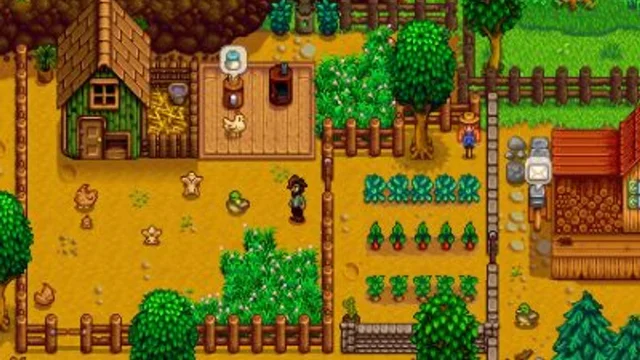
The farming loop is simple enough that you can pick it up in 30 minutes. The depth comes from the crafting system (processing crops into artisan goods like wine and cheese multiplies their value), the social layer (building friendship with the 12 marriageable characters and other townspeople unlocks new scenes and items), and the cave, which has 120 levels and gets progressively harder. None of these are required. That's the design.
Barone designed the game to be played without guides. He deliberately made the fishing system confusing at first, made the mining cave unpredictable, and kept the friendship mechanics opaque, because he wanted discovery to be the reward.3 A significant portion of players ignored this and immediately opened wikis, which he acknowledged was inevitable — just "not entirely in the spirit of the game."
What players are saying
The overwhelming consensus, across 50 million players and a decade of reviews, is that the game's greatest achievement is managing to feel both low-stakes and endlessly compelling at the same time.
What people love:
- The lack of a failure state. You can't lose Stardew Valley. You can have a bad season, run low on money, miss the fishing festival — nothing locks you out. Reviewers at Metacritic cite this specifically: "This game really helped me relax after a tiring day of work. The gameplay loop just works."4
- The breadth. The game is officially a farming sim but it contains a full dungeon crawler, a fishing game, a relationship/dating system, base building, cooking, crafting, and two different major storyline paths for the town. Giant Bomb's review called it "a one-man labor of love filled with seemingly endless content and heart."4
- Post-launch support. Barone released major free updates for years after launch — including an entirely new island area, a character rework, and the 1.6 update in March 2024 that added new farm types, items, and events. IGN reassessed the game after 1.6 and upgraded their score to 10/10, calling it "a modern classic."1
Where it genuinely frustrates people:
- The fishing minigame. This is the most-cited complaint across Reddit and Steam reviews. The mechanic requires you to hold a button to keep a small bar aligned with a bouncing fish icon inside a vertical window. On controller it's manageable; the first few hours on PC with a mouse are often described as actively unpleasant. Some players never make peace with it and simply skip the Fishing skill tree.
- Overwhelming content, especially for newer players. The most meaningful recent criticism, noted in the r/StardewValley community, is that there is genuinely too much to do now — the game has grown to a point where new players feel lost choosing between farming, fishing, the mine, town events, bundles, and the new island.5 The lack of structured guidance is the design intent, but it cuts both ways.
- The time-pressure anxiety. Barone's stated goal was a relaxing game. But the day-clock means many players end up rushing — trying to squeeze in one more task before 2 a.m. — which creates exactly the stress it was designed to avoid. One negative Steam review reads: "A pleasant game that never quite gelled for me where it matters. Elements of coziness are undermined by a few gameplay mechanics which contradicted that feeling."4
- Thin combat. The mining cave is largely optional, and if you engage with it expecting FromSoftware combat, you'll be disappointed. Enemies are simple, the sword animation is clunky, and there's no depth to the fighting system. It's more of a resource-gathering obstacle than a proper combat game.
Who it's not for: Players who need clear direction and defined goals at all times. The game is structurally open-ended by design — there's no quest marker, no "you should do this next" prompt, and the wiki is essentially required to play optimally. If that ambiguity sounds frustrating rather than freeing, this probably isn't the game for you. Also: players who cannot stand the fishing minigame. It doesn't get easier; you just get used to it.
The setup (no spoilers)
Your character has been working a corporate office job, grinding through spreadsheets for a company called Joja Corporation. Your grandfather died some time ago and left you a letter, sealed, to be opened "when you feel you've had enough." The game opens with you opening the letter. You inherit his farm in Stardew Valley.3
Stardew Valley is a small farming community. Pelican Town has about two dozen residents. Some of them are friendly immediately; others take time to warm to you; a few are actively unwelcoming. The town itself has a problem — a Joja Corporation store has opened nearby and is slowly draining the community of the things that made it worth living in. There's a ruined building in town called the Community Center that used to bring people together. It's falling apart now.
That's the premise. You can engage with it or ignore it entirely. The game doesn't force you down either path. What it's actually asking — without saying it directly — is whether you want to try to restore something that was lost, or whether you just want to grow crops and raise animals in a valley with a nice name.
The emotional register here is gentler than any other game in this channel's history. There are no combat consequences, no permadeath, no "you failed" screens. The difficulty is entirely self-imposed.
Should you play it?
If you've been playing intense games and want something that doesn't ask much of your reflexes or attention span in exchange for a surprisingly deep system to explore — yes, unambiguously. The 50 million sales figure and the Overwhelmingly Positive rating after nearly a decade on Steam aren't hype; they're the result of a game that keeps rewarding you differently depending on how you want to play it.6
Go in without a wiki if you can manage it. The first season of confusion is part of the experience.
이 콘텐츠를 둘러싼 관점이나 맥락을 계속 보강해 보세요.