Itaipu Dam: how two grid frequencies forced every engineering decision

Itaipu Dam: how two grid frequencies forced every engineering decision

In 1973, a single treaty clause — equal 50/50 energy ownership between Brazil (60 Hz grid) and Paraguay (50 Hz grid) — forced every major engineering choice at the Itaipu Dam into unusual territory. This case study traces the cascade: from the hollow gravity hybrid dam design that saved 4.3 million m³ of concrete, through the three-year diversion of the Paraná River, the 20 × 700 MW Francis turbines split across two frequencies, and the record-breaking ±600 kV HVDC bipoles that solved the frequency conversion problem at gigawatt scale. It covers Itaipu's 32-year world record for annual generation (103.1 TWh in 2016), the 2025 IEEE Milestone designation, the ongoing $649M GE Vernova digital modernization (2022–2036), and the unresolved Annex C treaty renegotiation suspended by an espionage scandal and resumed in November 2025 — with no final agreement as of June 2026.

Engineering Marvel Teardown
2026. 6. 5. · 23:30
구독 4개 · 콘텐츠 20개
In April 1973, Brazil and Paraguay signed a treaty to build a hydroelectric dam on the Paraná River. The treaty stipulated something that no dam designer had ever had to accommodate at this scale: the two countries would split ownership and energy output exactly in half, each taking 50% — but they ran their national grids at different frequencies. Brazil's grid ran at 60 Hz. Paraguay's ran at 50 Hz.
That single sentence in the treaty generated a cascade of engineering constraints. It meant the powerhouse would contain two incompatible sets of turbine-generators operating side by side. It meant the surplus electricity Paraguay could not use would have to be sold to Brazil, but it could not simply flow down a transmission line without first being converted from 50 Hz to 60 Hz — at the time, that conversion had never been done at anything close to this power level. It meant two separate substations, two separate transmission systems, and ultimately the longest and most powerful HVDC (high-voltage direct current) transmission system in the world at the time of its construction.
The dam itself — a 7,919 m structure containing 12.3 million m³ of concrete and standing 196 m tall at its highest point — was the physical solution to a political problem that predated it by more than a century. 1 What makes Itaipu worth studying carefully is not that it is large. It is that virtually every major engineering decision — what type of dam, how many turbines, how to transmit the power, how to manage floods, how to split a construction project across two sovereign states — was forced into unusual territory by the combination of constraints that no single-nation project would ever accumulate simultaneously.
The result is the facility that, as of its IEEE Milestone designation in March 2025, "produced more electricity annually than any other hydroelectric project" for at least three decades. 2

The treaty constraint: engineering for two sovereigns

The political background matters because it defined which technical options were even available.
Brazil and Paraguay had disputed a stretch of the Paraná River for more than a century. The 1966 Act of Iguaçu ended that dispute by committing both countries to jointly exploit the river's hydroelectric potential. 3 Seven years of binational engineering studies followed — ELC Electroconsult (Italy) and IECO (US, a Morrison-Knudsen subsidiary) won an international competition in 1970 to conduct the feasibility analysis — before the 1973 Itaipu Treaty established the legal framework. 1
The treaty created Itaipu Binacional, a binational entity co-owned equally by Eletrobras (Brazil) and ANDE (Paraguay), with a 14-member Administrative Council split equally between the two governments and a 12-member Executive Board operating the same way. 3 Every technical decision had to be ratified through this structure. As Itaipu Binacional itself put it: "Itaipu is not only the result of civil and electrical engineering, but also viewed as a diplomatic achievement that solved border disputes between Brazil and Paraguay that had been discussed for over a century." 4
Three engineering constraints emerged directly from the treaty architecture:
First, the 50/60 Hz split. Paraguay operated at 50 Hz; Brazil at 60 Hz. The treaty mandated equal energy sharing. That meant the powerhouse could not be designed as a single coherent electrical system — half the machines would run at one frequency, half at the other, within the same building, with 34 m of separation between adjacent units. 1 Any surplus generation from Paraguay's 50 Hz side that Paraguay could not consume would have to be sold to Brazil. Getting that power onto Brazil's 60 Hz grid required frequency conversion, which at 3,000+ MW scale meant HVDC transmission was the only practical option.
Second, the Argentine veto constraint. Argentina, downstream on the Paraná, had its own hydroelectric project (Corpus) planned for a site where any change in reservoir levels at Itaipu would directly affect the hydraulic head available. Negotiations took six years and produced the 1979 Tripartite Itaipu-Corpus Agreement, which capped the maximum number of simultaneously operating generating units at 18. 1 This constraint was eventually relaxed when units 19 and 20 were added in 2006–2007, but the original design had to accommodate it.
Third, equal equity with unequal consumption. Paraguay's domestic electricity demand was, and remains, a fraction of Brazil's. Under the original treaty, Paraguay was required to sell any of its 50% energy share that it could not consume back to Brazil at cost-based prices. 3 This was a source of Paraguayan political discontent for decades — the country owned half an enormously productive asset but received relatively modest financial returns on it until the 2009 renegotiation, when Brazil tripled its purchase payments and Paraguay gained the right to sell surplus power directly to Brazilian companies.
The financial architecture was also unusual. Paraguay had no capital to contribute to construction costs. Brazil's government guaranteed loans covering both shares; Paraguay would repay its debt through a portion of future energy revenues. Total construction cost reached approximately USD 19.6 billion (nominal), with debt financing that eventually totalled USD 27 billion including financial rollovers. 1 The debt was fully repaid around 2023, coinciding with the expiry of the treaty's original 50-year financial term — an event that triggered the ongoing Annex C renegotiation examined later in this article.

Moving the seventh-largest river

Before any concrete could be poured, engineers had to solve a problem that had no real precedent: building in the bed of the Paraná River — the seventh-largest river in the world by average discharge, carrying roughly 11,000 m³/s of water — required diverting the river entirely. 5
The chosen method was a bypass channel excavated through solid basalt on the Brazilian (left) bank. The dimensions were formidable: approximately 2 km long, 150 m wide, and 90 m deep — and all of it blasted and removed through continuous round-the-clock excavation from 1975 through 1978. 1 Approximately 50 million tonnes of earth and rock were extracted: enough fill, as construction-era accounts noted, to load a continuous line of dump trucks stretching three times around the Earth's circumference. 5
On October 14, 1978, the diversion channel gates were opened and the Paraná River was successfully rerouted — drying out a section of the original riverbed where the main dam and powerhouse would be built. The IEEE Engineering and Technology History Wiki, citing this as one of the two primary engineering obstacles (alongside controlled detonations for reservoir formation), describes the diversion as central to the project's claim to engineering significance. 2
PBS Building Big summarised the scale of what this required: "Engineers actually had to shift the course of the seventh largest river in the world, the Parana River, around the construction site before building the Itaipu Dam. It took almost three years for workers to carve a 1.3-mile-long, 300-foot-deep, 490-foot-wide diversion channel for the river." 5
The diversion structure functioned for four years while the main dam was constructed, then was permanently sealed as reservoir filling began in October 1982. What had been open Paraná River rapids — including the Guaíra Falls (Sete Quedas), which held the record as the world's largest waterfall by volume — was permanently inundated. 1 The falls had drawn an estimated 80 tourists to a viewing bridge on the last day before flooding began; the overloaded bridge collapsed and 80 people died. 3 The loss of Guaíra Falls remains the project's most irreversible environmental consequence.
The reservoir that formed is substantial: 1,350 km² in surface area — larger than the urban footprint of São Paulo — 170 km long, and holding 29 km³ of water. 1 Approximately 65,000 people were displaced: roughly 40,000 on the Brazilian side and 25,000 on the Paraguayan side, with USD 190 million paid in compensation. 3 The elimination of the natural fish barrier at Guaíra Falls triggered a documented invasion of more than 30 fish species from the lower Paraná into the upper Paraná basin, permanently altering the freshwater ecology of both systems. 1
In response to these ecological impacts, Itaipu Binacional later established what it describes as the largest reforestation program of its kind at the time — planting 20 million native tree seedlings and protecting 100,000 hectares of Atlantic Forest around the reservoir, a zone that received UNESCO Biosphere Reserve designation (Paraguay 2017, Brazil 2019). 4

Four dams in one: the hollow gravity decision
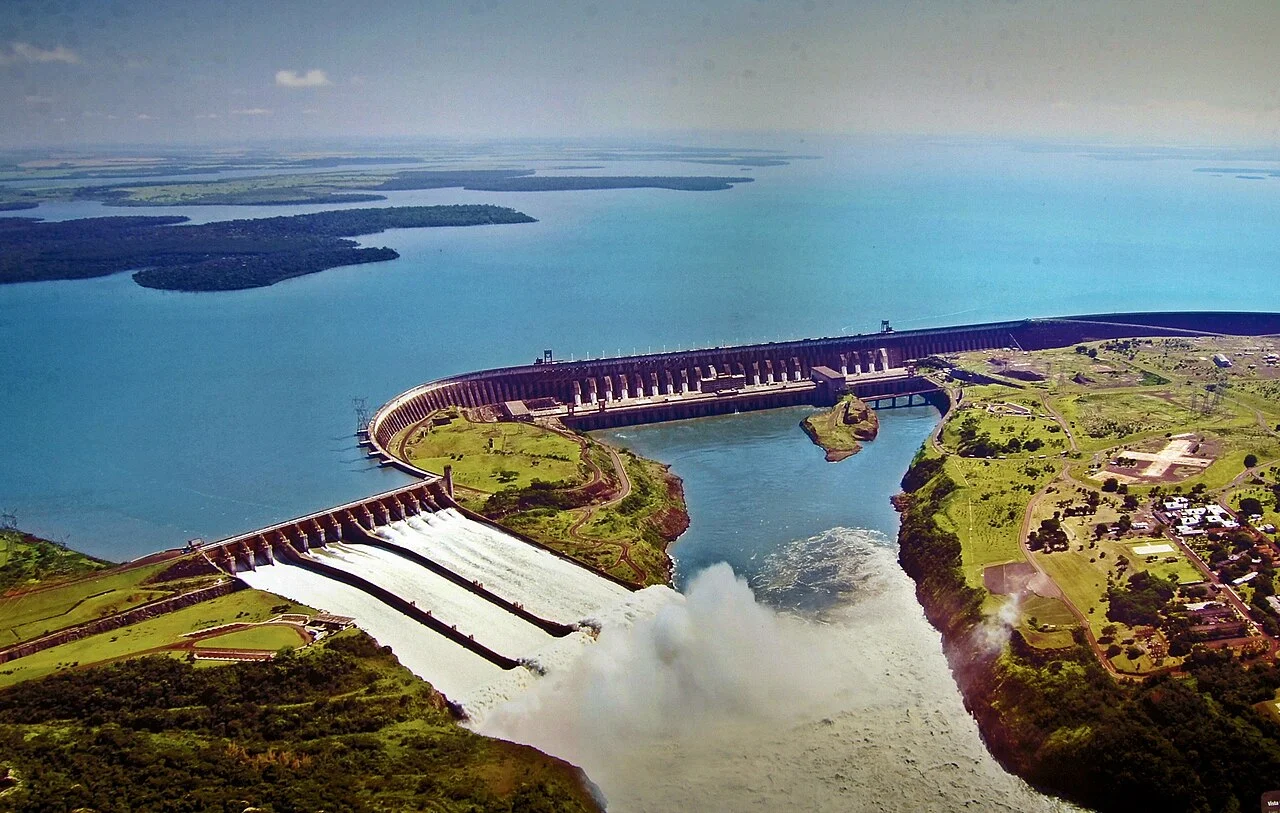
The curved Itaipu barrage from the air, showing the dam's sweeping horseshoe profile against the brown waters of the Paraná and the surrounding green lowlands
Aerial view of the Itaipu complex from a different angle than the cover, showing the horseshoe curvature of the main barrage, the powerhouse gallery at the base, and the gated spillway discharging at right. The earthfill and rockfill embankment sections that complete the full 7,919 m span extend to the left. 6
The 7,919 m total dam length crosses a geological cross-section that varies dramatically from one bank to the other. The Paraná sits in a basalt canyon at this point, but the basalt depth, fracture pattern, and overburden change significantly across the 8 km span. A single dam type applied uniformly across that span would have been either massively overbuilt on the competent rock sections or structurally inadequate on the softer zones. The engineers' solution was to design four distinct dam types, each matched to its local foundation conditions, and join them into a single continuous structure. 7
From left bank to right bank, the structure is: earthfill embankment dam (far left, where alluvial deposits preclude mass concrete), rockfill embankment dam (transition zone), hollow gravity buttress main dam (the central section holding the powerhouses and spillway), and concrete wing dam (right bank tie-in). The maximum height of 196 m — equivalent to a 65-story building — occurs at the reinforced concrete barrage section. 1
The critical design decision was the hollow gravity configuration for the central concrete section. Solid gravity dams resist water thrust entirely through their own weight: a wall of concrete so massive that the horizontal water load cannot overcome its friction and weight on the foundation. That works, but it requires an enormous volume of concrete, which at Itaipu's 196 m height would have been prohibitive. The hollow gravity alternative saves approximately 35% of the concrete volume by replacing solid interior mass with a ribbed hollow structure that keeps sufficient self-weight while eliminating redundant material from the interior. PBS Building Big's documentation of the design rationale is direct: "Engineers chose a hollow gravity dam because it required 35 percent less concrete than a solid gravity dam. The hollow dam is still heavy and sturdy enough to resist the thrust of water entirely by its own weight." 5
At 12.3 million m³ of concrete total, the 35% saving corresponds to roughly 4.3 million m³ of concrete not poured — or about 340 Hoover Dams' worth of avoided material. The base thickness of the hollow gravity section is 273 m, providing the wide footprint that distributes load across the basalt foundation without requiring the extreme depth of a conventional gravity monolith. 7
An arch dam — the alternative that produces the most efficient use of concrete through compressive arch action — was evaluated and rejected. Arch dams transfer load horizontally into the canyon walls; at 196 m height with the Paraná gorge geometry, the wall rock would have had to carry abutment loads on the order of several million tonnes per metre of height. More fundamentally, the variable geology across the 7.9 km span made a single arch unfeasible: an arch dam implies a narrow canyon with competent, roughly symmetric rock on both abutments. The Paraná site offered neither narrow geometry nor geological symmetry. The hybrid solution — four dam types addressing four different foundation regimes — was the only configuration that could span the full width without either under-designing or massively over-designing any section.
The spillway is a separate structure to the side of the main dam, not incorporated into the dam body. Its 483 m length contains 14 segmented radial gates feeding three ski-slope chutes whose curved geometry dissipates kinetic energy at the toe rather than allowing a direct plunge that would erode the channel. Maximum discharge capacity: 62,200 m³/s — enough to evacuate approximately 40 times the average flow of the nearby Iguaçu Falls. 2 For context, the entire average flow of the Paraná is about 11,000 m³/s; the spillway design accommodates a probable maximum flood that is roughly six times that average flow.
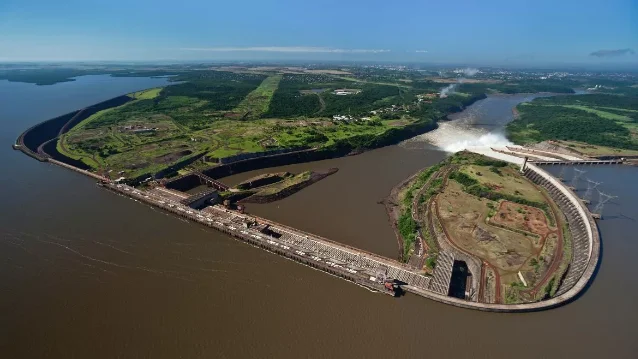
The main barrage of Itaipu seen from the downstream face — the hollow buttress profiles of the concrete dam structure are visible along the full 7.9 km crest
The downstream face of Itaipu's main concrete barrage. The regular pattern of hollow buttresses — visible as the repeating arched openings along the face — is the structural signature of the hollow gravity design that saved approximately 4.3 million m³ of concrete compared to a solid gravity alternative. 1

Twenty turbines, two frequencies

The powerhouse contains 20 Francis-type turbine-generator units, each rated at 700 MW, for a total installed capacity of 14 GW. 4 Ten of those units generate at 50 Hz for Paraguay; ten generate at 60 Hz for Brazil. The machines are physically identical in hydraulic terms — same design head of 118 m, same Francis runner geometry — but the generators are wound differently to produce the correct electrical frequency. As Wikipedia's documentation notes: "Of the twenty generator units currently installed, ten generate at 50 Hz for Paraguay and ten generate at 60 Hz for Brazil." 1
Francis turbines were the appropriate choice for Itaipu's hydraulic conditions. A Francis runner uses a mixed-flow configuration — water enters radially from a spiral casing, passes through adjustable guide vanes, then through the runner, and exits axially downward into the draft tube. The geometry efficiently extracts energy across a wide range of heads and flows, which is essential when reservoir levels fluctuate seasonally and the effective head changes accordingly. At Itaipu's design head of 118 m and a runner handling approximately 700 m³/s per unit, the Francis configuration achieves efficiencies above 92%. 8
The runners were, at the time of manufacture, the largest Francis runners ever built — with a diameter in the range of approximately 8.5 m, pushing the boundaries of both materials science and the casting and machining capabilities of the manufacturers involved. 1 The actual head at Itaipu often exceeds the design value during high-reservoir periods, and individual units frequently deliver power exceeding 750 MW — more than their rated capacity — as a result. 1
The 50/60 Hz constraint generated a second, more complex engineering problem: how to transmit Paraguay's surplus generation to Brazil. Direct AC transmission would simply deliver 50 Hz power onto a 60 Hz grid — a configuration that, unless immediately corrected, would destabilize every generator connected to that grid within seconds. The solution was HVDC (high-voltage direct current) transmission, which converts AC to DC at the sending end, transmits DC along an overhead line with lower losses over long distances than an equivalent AC line, and converts back to AC at the receiving end — at whatever frequency the receiving grid requires.
This is precisely what Hitachi Energy (then ABB) built for Itaipu: two ±600 kV HVDC bipoles, each rated at 3,150 MW, for a total HVDC transmission capacity of 6,300 MW — the largest and most powerful HVDC system in the world for more than 20 years after its commissioning. 9 Each bipole runs approximately 800 km from the Foz do Iguaçu converter station (which rectifies the 50 Hz AC into DC) to the Ibiúna inverter station near São Paulo (which converts DC back to 60 Hz AC). Bipole 1 began operation at 300 kV in October 1984, upgraded to its full ±600 kV rating in July 1985. Bipole 2 followed in July 1990. 9
Hitachi Energy's own documentation of the project articulates both the technical and economic rationale: "HVDC was chosen partly to supply power from the 50 Hz generators to the 60 Hz system, and partly because an HVDC link was economically preferable given the long distance involved." 9 The 800 km distance places the Foz do Iguaçu–São Paulo link well past the AC/HVDC economic crossover distance (approximately 600–700 km for overhead lines at this power level), so HVDC was the right choice even setting aside the frequency conversion requirement. The frequency problem made it mandatory; the economics made it optimal.
The scale of what these converter stations represented in the early 1980s should not be understated. Hitachi Energy noted that the Foz do Iguaçu and Ibiúna stations "represented a considerable step forward in HVDC technology compared to the HVDC stations of the 1970s" and that the stations "are still unique in their combination of size and advanced technology." 9 The system was eventually superseded in 2010 when the Xiangjiaba–Shanghai ±800 kV HVDC line (rated at 6,400 MW) entered service in China.
The 50/60 Hz split also required a second, separate substation complex on the AC side of each powerhouse. The 50 Hz GIS (gas-insulated switchgear) substation connects to six 500 kV AC transmission lines delivering power to the Paraguayan grid and to the HVDC rectifier at Foz do Iguaçu. The 60 Hz GIS substation feeds three to four 500 kV AC lines directly into Brazil's southeastern grid. 1 Two fully independent transmission systems, for two incompatible grids, emanating from the same building on the same river.
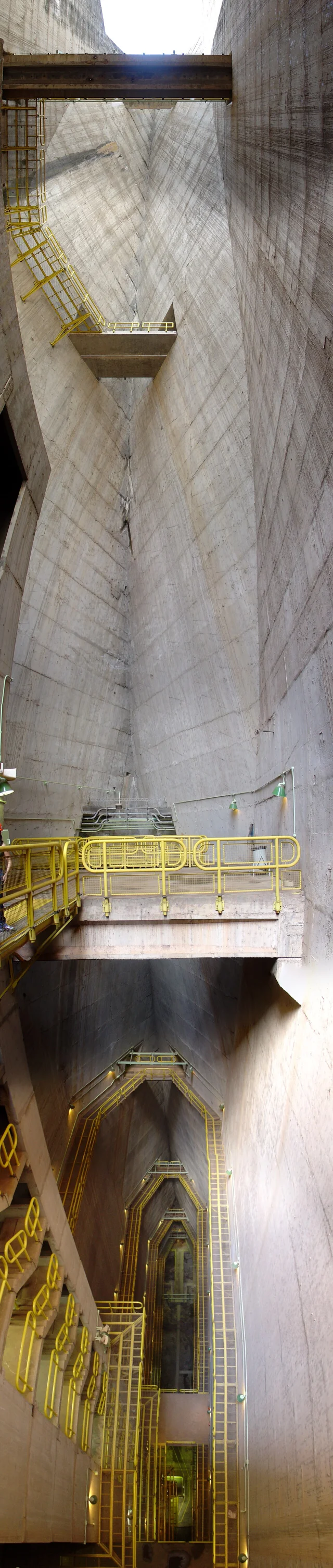
The interior of the Itaipu powerhouse, looking down the length of the turbine hall — the penstocks descend from the dam face to the turbine inlets visible below the gallery level
Inside the Itaipu powerhouse looking toward the turbine hall. The gallery overlooks the penstocks — the large-diameter steel pipes that carry water under pressure from the reservoir to each of the 20 Francis turbine inlets. Each unit handles approximately 700 m³/s. 1

Construction at scale: 14 years and 12.3 million m³

The construction program ran from January 1971 (preliminary works) through May 5, 1984 (first commercial power), with peak workforce of approximately 40,000 Brazilian and Paraguayan workers on site simultaneously. 2
Civil works were split between two national consortia: Unicon (Brazil) and Conempa (Paraguay) handled the dam and civil structures. Electromechanical assembly was carried out by Itamon (Brazil) and CIE (Paraguay). 1 The binational structure required that every major work package have a corresponding contractor on each side.
The concrete logistics alone constituted a manufacturing operation unprecedented in South America. On-site infrastructure included four rock-crushing centres with a combined capacity of 2,430 tonnes per hour, six concrete mixing plants each rated at 180 m³/h, two monorail systems for horizontal transport, seven aerial cableways for vertical placement, and 13 tower cranes working simultaneously. 1 On November 14, 1978 — in the middle of the main dam concreting campaign — the site set a South American record that still stands: 7,207 m³ of concrete poured in a single day, equivalent to a 10-story building's worth of material every hour around the clock for 24 consecutive hours. 1
Turbine installation began with first commercial power from Unit 1 on May 5, 1984, and proceeded at a rate of roughly two to three units per year. The first 18 units were in service by 1991, consistent with the original Argentine-imposed cap. Units 19 and 20, approved after the 1991 revision of the Tripartite Agreement, were commissioned in 2006 and 2007 respectively, bringing installed capacity to the full 14 GW. 1
The total excavation figure — 60 million m³, of which 50 million tonnes were earth and rock removed during the diversion channel and foundation preparation — dwarfs comparable projects by most metrics. ASCE comparisons note the excavation was 8.5 times greater than the total excavation for the Channel Tunnel; the concrete volume is 15 times the Channel Tunnel's. The total iron and steel used in the project, if fabricated into Eiffel Tower replicas, would yield 380 of them. 5
The GI Hub's infrastructure case study flagged one governance failure embedded in this success: "The procurement of the project was widely exposed to corruption at the construction stage, as the politicians in power encouraged the selection of private companies that had ties with political figures." 3 Itaipu Binacional subsequently built a compliance architecture that now includes Sarbanes-Oxley adherence (2006), a General Ombudsman (2009), and an Ethics Committee — a remediation arc that tracked the evolution of international infrastructure governance norms over the following two decades.
One governance innovation that did work from the outset: Itaipu Binacional in 1974 established a Construction Consultants Board — a standing panel of international dam engineering experts that reviews the facility's safety and structural performance every four years, conducting independent inspections and analyzing monitoring data. As the GI Hub records: "Itaipu Binacional created in 1974 a Construction Consultants Board, a group of international dam engineering experts that every four years analyses the performance of Itaipu's construction structures, conducting inspections and analysing data to assess operating and safety conditions." 3 This model has since been adopted by other major dam operators.

Generation record and engineering legacy
차트를 불러오는 중…
On December 31, 2016, Itaipu set a world record for annual hydroelectric generation: 103.1 TWh in a single calendar year. 1 That record held for four years, until Three Gorges Dam — which has 22.5 GW of installed capacity against Itaipu's 14 GW — produced 111.8 TWh in 2020, aided by exceptional Yangtze River flooding. 1
The comparison between the two facilities reveals something about how Itaipu's design choices played out over time. Three Gorges has 60% more installed capacity, yet for the period 2012–2021 it averaged 97.22 TWh per year against Itaipu's 89.22 TWh. 1 Itaipu's advantage is capacity factor — the ratio of actual generation to the theoretical maximum if the plant ran at full nameplate output continuously. Itaipu's capacity factor was 62.3% in 2020, 1 reflecting relatively stable Paraná River flow across most years. Three Gorges operates more intermittently because seasonal Yangtze flood management constrains how long the plant can run at peak.
The cumulative generation figure drives home why the IEEE Milestone designation, awarded in March 2025, described Itaipu as "the single plant that has produced the most energy in history": from first commercial power in May 1984 through 2020, Itaipu generated approximately 2,764,589 GWh — nearly 2.76 petawatt-hours. 2 Over the same period, it provided roughly 90% of Paraguay's electricity and 10–15% of Brazil's. 10
Those proportional figures carry serious system implications. When a November 2009 storm damaged three high-voltage transmission lines from Itaipu simultaneously, Paraguay blacked out within 15 minutes. Rio de Janeiro and São Paulo lost power for more than two hours. Approximately 50 million people were affected. 1 The event was a demonstration of both the scale of Itaipu's contribution to South American electricity supply and the single-point vulnerability that any grid dependent on one large facility must manage. It accelerated investments in transmission redundancy across Brazil's southeastern interconnected system.
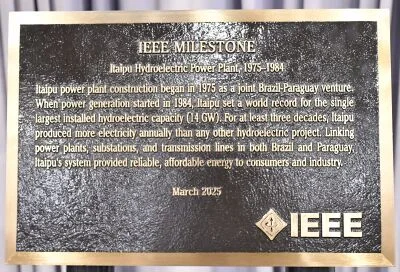
The IEEE Milestone plaque dedicated at the Itaipu visitor center in Hernandarias, Paraguay, on March 27, 2025
The IEEE Milestone #266 plaque, dedicated March 2025 at the Itaipu Hydroelectric Power Plant visitor center, Hernandarias, Paraguay. The citation recognizes Itaipu's 1975–1984 construction and its record of producing more electricity annually than any other hydroelectric project for at least three decades. 2
The ASCE designated Itaipu one of the Seven Wonders of the Modern World in 1994, as published in Popular Mechanics in December 1995. 1 The techniques validated or pioneered at Itaipu's scale subsequently influenced several generations of large dam engineering:
  • River diversion methodology: The strategy used on the Paraná — excavating a bypass channel through the adjacent basalt, then gating it closed after the main dam was complete — was studied and adapted for the Three Gorges Yangtze diversion (1997–2002), where similar logic applied to a river of comparable magnitude.
  • Large Francis turbines: Itaipu's runners, at approximately 8.5 m diameter, were the largest manufactured at the time and pushed both casting technology and dynamic balancing capability to their limits. Three Gorges' runners reached 10.4 m — a direct extension of the manufacturing envelope first proven at Itaipu.
  • HVDC for frequency bridging: The Foz do Iguaçu–Ibiúna bipoles established that HVDC transmission could reliably handle frequency conversion at gigawatt scale and long distances. That precedent directly informed subsequent continental interconnections — including several AC/DC hybrid schemes in Europe and China — where asynchronous grids needed to exchange power.
  • Construction Consultants Board: The four-year independent safety review cycle, established by Itaipu Binacional in 1974, became a model for dam safety governance globally, influencing ICOLD (International Commission on Large Dams) guidelines for independent review of major hydraulic structures.

What's actively changing: modernization, drought, and a renegotiation under espionage shadow

Forty years after first power, Itaipu is mid-project in the largest overhaul it has ever undergone — and simultaneously navigating a political renegotiation that could reshape energy costs for 215 million Brazilians and 7 million Paraguayans for decades.

The GE Vernova modernization (2022–2036)

On May 3, 2022, Itaipu Binacional signed a USD 649–660 million, 14-year contract with the CMI Consortium — led by GE Vernova (Hydro + Grid Solutions), with CIE SA (Paraguay, assembly) and Tecnoedil SA (Paraguay, general materials) — for the largest technological upgrade in the plant's history. 11 6
The scope covers all 20 generating units (the turbines themselves were not replaced — they remain mechanically sound — but the measurement, protection, control, regulation, and monitoring systems around each unit will be entirely replaced with new digital equipment). New systems include SCADA (Supervisory Control and Data Acquisition), Energy Management Systems (EMS), Network Automation Technologies, medium-voltage switchgear, protection and control systems for both GIS substations and the 500 kV transmission lines, and two new compact GIS substations for auxiliary electrical services. 11 12
The rationale behind the modernization was candid. David Krug, Itaipu's Executive Technical Director, explained in 2022: "If we upgrade the plant technologically, the problem of spare parts is eliminated. The big advantage is this — we are upgrading the plant to a new state of the art facility and, in doing so, improving the efficiency of the operation and maintenance processes." 12 Many of the original analog control systems date to the 1970s and 1980s; some manufacturers no longer exist, making spare parts procurement progressively harder.
One notable addition within the modernization scope: Itaipu will become, in GE Vernova's description, "the first such facility with its own cybersecurity system" — a recognition that the control architecture of a 14 GW plant feeding two national grids is a target profile that its original 1970s-era design never anticipated. 11 As of GE Vernova's November 2025 feature on the project, key engineering and testing phases had been completed; the critical SCADA, EMS, and network automation systems were scheduled for installation in 2026, with the first turbine expected to undergo its control system retrofit that same year. Pascal Radue, CEO of GE Renewable Energy at the time of signing, put it plainly: "It is an honor and an obligation for us to participate in this largest technological upgrade project of Itaipu since its commissioning." 12

Drought operations and the "Water Windows" protocol

The 2020–2021 Paraná River basin drought dropped Itaipu's reservoir to an unprecedented 17% of storage capacity and cut annual generation to approximately 66,000 GWh in 2021 — one of the plant's driest operating years since commissioning. 13 The drought exposed a tension between Itaipu's hydroelectric optimization and downstream water users.
The Itaipu Governing Council authorized three controlled water releases under what it called "Water Windows" operations — on May 18, 2020; August 3, 2020; and May 21, 2021 — prioritizing navigation and water supply for downstream Argentina and Paraguay over maximum energy extraction. The decision rested on the international law principle of equitable and reasonable use of transboundary rivers, with input from an intergovernmental commission that included shipping company representatives. 14 Maria A. Gwynn, a former Governing Council member and author of a 2023 analysis of the episode, described these operations as "often cited as a successful example in regional practices of international cooperation in the utilization of international rivers for diverse purposes." 14
Recovery has been gradual. Generation rebounded to 83.9 TWh in 2023 and 72.9 TWh in 2025 — the 2025 output rising 8.63% from 2024, though climate analysts at Brazil's National Water and Sanitation Agency (ANA) note that the hydropower sector "will have to cope with more floods and droughts — which will lead to greater operational difficulties" as climate variability increases. 13

Annex C renegotiation: espionage, asymmetric costs, and no resolution yet

The treaty's Annex C — which governs Itaipu's financial terms, including the tariff at which Brazil purchases Paraguay's surplus electricity — became eligible for renegotiation when the treaty's original 50-year financial term expired in October 2023, coinciding with full repayment of the plant's construction debt. 15
Talks produced a May 2024 interim Asunción Agreement setting a provisional tariff of USD 19.28 per kW of contracted monthly power, valid through 2026. 13 Then they stalled badly. In April 2025, Brazilian media revealed that ABIN, Brazil's national intelligence agency, had conducted an espionage operation against Paraguayan officials' computers between June 2022 and March 2023 — specifically to obtain intelligence on Paraguay's negotiating positions for the Annex C talks. The operation occurred under the Bolsonaro administration. The Lula government said it had nullified the operation upon discovering it. Paraguay suspended negotiations entirely. 15
Negotiations resumed after Brazil's Foreign Minister Mauro Vieira and Paraguay's Foreign Minister Rubén Ramírez Lezcano signed a joint communiqué on November 17, 2025, with Paraguay declaring the espionage matter "closed" following receipt of a confidential intelligence report. 16 As of June 2026, no final Annex C replacement text has been publicly announced.
The stakes in this negotiation are substantial. A January 2026 analysis by Valor International found that in 2025, Brazil bore 78.5% of Itaipu's Unit Cost of Electricity Services (Cuse) while receiving only 64.44% of the output — paying an average USD 47.35/MWh against Paraguay's USD 23.17/MWh, with approximately USD 395.9 million of energy effectively consumed by Paraguay but paid for by Brazilian consumers. 17 Of the 5.74 TWh increase in 2025 output from the prior year, 96% was allocated to Paraguay. 17
Academic experts in Brazil argue the tariff structure has departed from the treaty's cost-basis framework. Alexandre Street (Associate Professor, PUC-Rio) put it plainly: "The problem is not technical or economic. It is legal and ethical." 17 Jerson Kelman, a former director of Brazil's National Electricity Regulatory Agency (ANEEL), framed the stakes differently: "Is failing to reduce electricity bills for millions of Brazilians in order to amass more than R$6bn in 2024 for discretionary use by Itaipu's board of directors a burdensome commitment to national coffers or not? I think it is." 17
Paraguay's analytical position is structurally constrained. As political analyst Julieta Heduvan observed in a separate assessment, "Paraguay is at a disadvantage because of its relative position in the world and the enormous asymmetries it has in relation to Brazil." 13 The country receives ~90% of its electricity from Itaipu and depends on the plant's royalties as a meaningful share of national revenues. Agreeing to a lower tariff reduces the discretionary income available to Paraguay's government; refusing to agree prolongs the interim arrangement that already runs at a tariff Brazilian experts call too high.

What Itaipu changed

Itaipu's engineering choices fed into subsequent practice through several distinct channels.
The HVDC transmission architecture was the most direct export. The Foz do Iguaçu–Ibiúna bipoles demonstrated that long-distance, high-power DC transmission at the ±600 kV level was operationally reliable across a 14-year (and beyond) horizon. That validation gave utilities and governments confidence to pursue similar configurations on scales that would otherwise have seemed speculative. By the time China began commissioning its own ±800 kV Ultra High Voltage DC (UHVDC) lines in the late 2000s, the basic operating model had been proven at Itaipu for more than two decades.
The hybrid dam design at 196 m height validated a structural approach that had been used at smaller scales but never at this combination of height, geological variability, and total volume. Joining earthfill, rockfill, hollow gravity, and concrete wing sections into a single coherent hydraulic structure — matching each section's type to its local foundation regime — has since become standard practice for large dams in geologically heterogeneous sites. No single dam type now defaults to being "correct"; foundation conditions drive selection, and Itaipu demonstrated that mixed-type solutions can be both structurally sound and economically optimal.
The Construction Consultants Board model — independent, internationally constituted, operating on a fixed cycle — became a governance benchmark. ICOLD's safety review guidelines for large dams now recommend or require similar independent review structures; Itaipu's 1974 establishment of that board predates those guidelines by more than a decade.
The binational governance model itself — equal ownership, mirror management structures at every level, compulsory energy sharing with market-adjusted surplus pricing — has been studied extensively as a template for transboundary infrastructure. The complications it generates (the 50/60 Hz split, the Annex C asymmetry, the Argentine veto negotiations) are well documented. So is the central fact: the dam was built, ran continuously for more than four decades, and produced more cumulative electricity than any single facility in history.
The IEEE Milestone plaque, installed at Hernandarias in March 2025, summarizes the engineering achievement in the terms that most matter: "Itaipu set a world record for the single largest installed hydroelectric capacity (14 GW). For at least three decades, Itaipu produced more electricity annually than any other hydroelectric project. Linking power plants, substations, and transmission lines in both Brazil and Paraguay, Itaipu's system provided reliable, affordable energy to consumers and industry." 2
Forty years of uninterrupted operation — through droughts, political disputes, a grid blackout affecting 50 million people, and now a $650 million digital overhaul — is the engineering result. The treaty that forced all those difficult decisions into one project also forced engineers to solve them. The solutions are now standard practice elsewhere.

Cover image: Aerial view of the Itaipu Dam complex. Image from Wikipedia: Itaipu Dam, licensed CC BY-SA 3.0.

이 콘텐츠를 둘러싼 관점이나 맥락을 계속 보강해 보세요.

  • 로그인하면 댓글을 작성할 수 있습니다.