Friday market scorecard — June 5, 2026
172K jobs and the Nasdaq's worst week in over a year: what happens when good news is bad news
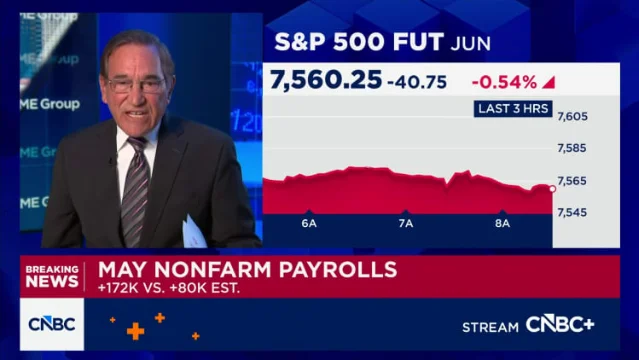
May payrolls printed 172,000 — more than double the 80K consensus — sending the Nasdaq down 4.2% Friday and 4.7% for the week, its sharpest decline in more than a year. The Philadelphia Semiconductor Index erased over $1 trillion in a single session. Rate-hike odds jumped to ~70% by year-end, with Warsh's first FOMC meeting just 11 days away.
May payrolls print 172K — double the forecast — and the Nasdaq posts its worst week in more than a year. The chip complex drops over $1 trillion in market value on Friday alone. Warsh's first FOMC meeting is in 11 days.
The number that broke the rally
Nine weeks of gains ended abruptly Friday. The Bureau of Labor Statistics reported 172,000 nonfarm jobs added in May — more than double the 80,000 consensus estimate and above the upwardly revised 179,000 in April.1 The unemployment rate held at 4.3%, wages grew 0.3% month-on-month and 3.4% year-on-year, both in line with expectations.1
正在加载统计卡片…
Prior-month revisions made the picture even hotter: March was revised up 29,000 to 214,000; April up 64,000 to 179,000 — a combined 93,000 additional jobs, pushing the three-month average to roughly 188,000.2 Leisure and hospitality led sector gains with 70,000 hires — five times its prior 12-month monthly average — possibly pulled forward by World Cup hiring.1
"The hiring recession is over. American firms are hiring again. This is a strong jobs report from every angle." — Heather Long, chief economist, Navy Federal Credit Union 1
Strong economic data is supposed to be good. Stocks don't always agree.
How tech stocks got hit
The Nasdaq Composite closed down 4.18% — its worst single session since April 2025 and its worst week (down 4.7%) in over a year, ending the S&P 500's nine-week winning streak.3 The S&P 500 fell 2.64% to 7,383.74; the Dow shed 1.35% to 50,866.78.3
The Philadelphia Semiconductor Index suffered its largest single-day percentage drop since March 2020, erasing more than $1 trillion in market value in a single session.4 Among the largest decliners:
| Name | Friday close change |
|---|---|
| Broadcom (AVGO) | –7.9% (extending 3-day selloff past –20%) |
| Micron (MU) | –13.3% |
| AMD | –10%+ |
| Intel (INTC) | –10%+ |
| ARM Holdings | –10%+ |
| Nvidia (NVDA) | –6.2% |
| Marvell (MRVL) | –10%+ |
| Qualcomm (QCOM) | –10%+ |
Tech overall fell 5.8% as the S&P 500's weakest sector Friday; consumer staples was the only gainer.4
"After the record run we've seen the last nine weeks in equities, specifically tech and semiconductors, the dam just broke today." — Ryan Detrick, chief market strategist, Carson Group 4
Wells Fargo's Ohsung Kwon offered a counter-take: "The market reaction today was more driven by positioning rather than fundamentals. The semiconductor sector was way overbought. I don't think it's the end of the semi bull market."4
Why a hot jobs print hits AI stocks hardest
Fast-growing tech companies, particularly those projecting profits years out, are acutely sensitive to rate expectations. Higher yields discount those future earnings more aggressively — the same mechanism that punished the sector in 2022.
The 10-year Treasury yield jumped past 4.52% following the report; the 2-year — the Fed-policy barometer — climbed to 4.16%, its highest in a year.3 Prior to the 8:30 a.m. release, traders had roughly 50% odds of a Fed rate hike by year-end. By mid-session that figure had jumped to ~70%.3 By Friday's close, Benzinga reported CME FedWatch was pricing a 96% probability of at least one rate hike by December's FOMC meeting — up from roughly 25% in mid-May.5
正在加载图表…
The October 28 meeting is now priced at 59% odds of the first hike. A second hike by April 2027 is priced at 61%.5 The current Fed funds target sits at 3.50–3.75%.
President Trump posted Friday that "With a great Jobs Report, like just announced, stocks should go up, not down," adding "Growth does not mean inflation!" — a tension already visible in the market's sharp divergence between the Dow (which fell a more modest 1.35%) and the rate-sensitive Nasdaq (–4.18%).3
Morgan Stanley's Ellen Zentner made a distinction markets still debated at close: "Rate cuts still aren't on the near-term horizon, but the absence of inflationary threats in today's report should quiet some of the chatter about a potential hike."1
AVGO: third day of pain
Broadcom, which already fell roughly 6% Wednesday night after its Q3 AI semiconductor guide of $16 billion came in ~$1.2 billion below the highest analyst estimates, dropped another 7.9% Friday, making it the most prominent single stock casualty of the week.3 The three-day loss from its pre-earnings high near $480 reached roughly 20-plus percent, with the stock changing hands below $380 at session lows before closing in the low $380s. Macquarie's Thursday downgrade to Neutral with a $437 price target — citing Google insourcing risk — added a fundamental layer on top of the macro selloff.
Two sideshows worth flagging
S&P rebalancing decision on SpaceX. S&P Global confirmed Friday it will not change eligibility requirements for major indices, effectively ruling out a fast-track entry for SpaceX to the S&P 500 even when the company goes public in what would be the world's largest IPO.4 Marvell Technology, with a market cap now above $270 billion after its post-Nvidia-halo surge earlier this week, remains a prime candidate for an upcoming S&P 500 addition once eligibility criteria are met.4
Non-tech casualties. Lululemon Athletica fell 8.6% after cutting its annual profit forecast and guiding second-quarter EPS well below consensus.4 Crypto-adjacent names got swept in the risk-off move: Coinbase –7.1%, Strategy –6.9%, matching bitcoin's 4.1% drop.4
What to watch next
Warsh's FOMC debut, June 16–17. Kevin Warsh chairs his first policy meeting less than two weeks from now — inheriting a labor market running above consensus and April CPI at 3.8%, its highest since May 2023.5 The June 17 meeting itself is currently priced at 98.2% for no change — markets expect the hike cycle to start no earlier than October. But if Warsh signals a tightening bias in his post-meeting press conference, AI-heavy growth names will feel that more acutely than anything else in the S&P 500.5
Iran and oil. WTI closed around $90.25 Friday — down on the day after the broader risk-off move reduced speculative positions — but the Iran-Israel-Hezbollah dynamic around the Strait of Hormuz remains unresolved. Fading hopes for a Hormuz reopening are keeping energy costs elevated, which complicates the inflation picture Warsh will inherit.4
AVGO and the chip complex into next week. Broadcom's post-earnings analyst divergence — Macquarie at $437, Jefferies at $550, Wells Fargo at $545 — leaves a wide range of fair-value targets. Any Fed language that reduces rate-hike probability would likely trigger a relief bounce in semis; any continuation of the hawkish narrative accelerates the de-rating of AI growth names that drove the rally from April through May.
Volume Friday was 22.89 billion shares on U.S. exchanges, well above the 20.29 billion session average of the prior 20 days — the selloff was broad, deliberate, and not thin.4
参考来源
- 1Jobs report May 2026: CNBC
- 2May Jobs Report: Nonfarm Payrolls Surge 172,000 — Interactive Brokers
- 3Stock Market Today: Nasdaq Suffers Worst Week in More Than a Year — WSJ
- 4Wall Street ends sharply lower as chips slide — Reuters/Virginia Business
- 5Trump's Rate-Cut Dream Hits A Wall: Warsh May Be Forced To Hike — Benzinga
围绕这条内容继续补充观点或上下文。