20 new species named May 25: a Galápagos deep-sea octopus, three hadal protists from 10,000 m, an endangered Mexican cycad, and a Monday haul from Zootaxa
Monday, May 25, 2026 yielded 20 new species across five kingdoms. Zootaxa Vol. 5814 No. 4 contributes 16 species and a new genus (insects, fish, molluscs spanning South America, Asia, Galápagos, and deep sea); WoRMS registers three hadal protists — including two species in a brand-new family (Plumettidae) — from the Kermadec Trench at ~9,900–9,977 m; and Novataxa's Monday aggregation surfaces four plants and a reed snake published May 7–21. The fossil section adds a new cowrie variety and three new subfamilies from Oman. The lead species, Microeledone galapagensis, is a tiny deep-sea octopus that forced a revision of its entire family diagnosis.

Monday, May 25, 2026 confirmed 20 new species across five kingdoms, driven by a bumper issue of Zootaxa (Vol. 5814 No. 4 — 16 species and 1 new genus), same-day WoRMS registrations of three new hadal protists from the Kermadec Trench, and a half-dozen plants and a snake blogged by Novataxa from publications earlier in the month. The full haul spans deep ocean trenches, Amazonian river basins, Galápagos seamounts, Guizhou clifftops, Guerrero pine forests, and a spring in southern Thailand. 1
Deep-sea highlights
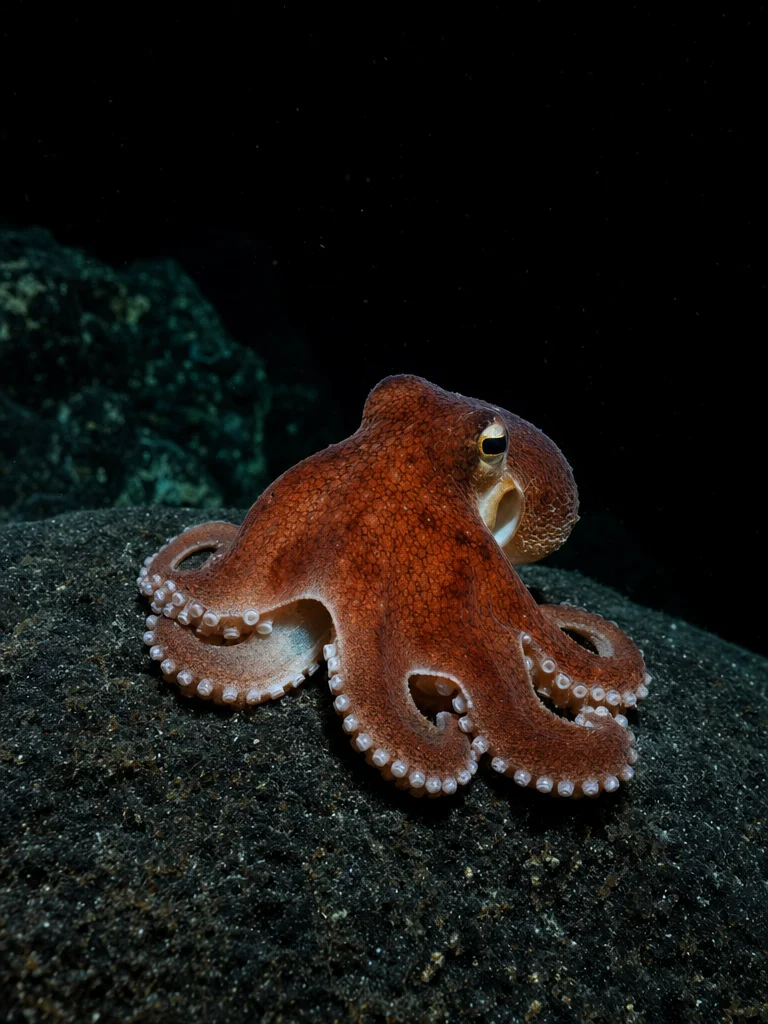
Microeledone galapagensis — a tiny octopus from Galápagos depths
The most structurally unusual animal named this window is an octopus collected from 1,773 m depth near Darwin Island, Galápagos Islands — the remotest point in an already remote archipelago. 2
Taxonomy: Animalia → Mollusca → Cephalopoda → Octopoda → Incirrata → Megaleledonidae → Microeledone
The species was described from a single female specimen. Microeledone galapagensis is squat and short-armed, with smooth skin, dense dark pigmentation on the dorsal mantle musculature but a pale ventral surface — a pattern of reverse countershading previously unrecorded for the genus. 2 The arms bear few suckers and the body lacks a crop diverticulum, ink sac, and anal flaps — traits that link it morphologically to Thaumeledone — but its smooth skin and large rachidian tooth place it firmly in Microeledone. Before this description, only one other species (M. mangoldi) was known in the genus.
Microeledone galapagensis also forces a revision. Its family, Megaleledonidae, was defined as containing large-bodied Southern Ocean endemics. A small octopod from tropical Pacific depths does not fit that definition, and the describers — Janet Voight (The Field Museum), Stephanie Smith, Salome Buglass, and Alexander Ziegler — revised the family diagnosis accordingly. As Voight et al. wrote: "This species belies the definition of the Megaleledonidae as large-bodied, Southern Ocean endemics, leading us to revise the family diagnosis." 2
The team also hypothesize that the short arms and few suckers in both Microeledone and Thaumeledone may reflect heterochrony — a change in developmental timing — possibly freeing energy for reproduction and enabling finer ecological partitioning among deep-sea octopod lineages.
Conservation status: Not Evaluated (IUCN).
Waisiuconcha takashii — a clam bridging two cold seeps 2,400 km apart
Chemosymbiotic clams in the family Vesicomyidae (order Venerida) sustain themselves at cold seeps using sulfur-oxidizing bacteria housed in their gill tissue. Waisiuconcha takashii sp. nov., named by Kazutaka Amano and colleagues, was collected at two seep sites: Oomine Ridge, Nankai Trough (2,526 m, Japan) and South Chamorro Seamount, Mariana Forearc (2,915 m). 3
Taxonomy: Animalia → Mollusca → Bivalvia → Heterodonta → Venerida → Vesicomyidae → Pliocardiinae → Waisiuconcha
The shell reaches 34.4 mm in maximum length and is distinguished from the only other Waisiuconcha species (W. helios) by a larger shell overall, a pronounced subumbonal pit, and a steeply inclined anterior cardinal tooth. A single papilla-like projection on the inner vulva of the inhalant siphon — previously known only from the allied genus Calyptogena — appears here for the first time in Waisiuconcha. 3
The same species occurring at two sites roughly 2,400 km apart adds to mounting evidence that pliocardiin clams can disperse over vast distances, probably carried by deep currents during larval stages. The study also provides the first molecular data (cytochrome oxidase I, COI) for the genus Waisiuconcha, anchoring future comparisons. 3
Conservation status: Not Evaluated (IUCN).
Hadal protists: two new foraminifera and a cercozoan
The deepest new taxa this window are not animals at all. On May 25, curator François Le Coze registered three single-celled protist species in WoRMS, all described from hadal depths (roughly 9,900–9,977 m) in the Kermadec Trench, South Pacific. The formal descriptions appeared in Science on May 14 as part of a paper by Xikun Song, Andrew Gooday, Daniel Leduc, Xiaodong Peng, and 16 co-authors reporting hard-substrate protist and metazoan faunas from 9,000–10,898 m depth in both the Kermadec and Mariana trenches. 4
Taxonomy of the three new species:
- Plumetta compacta Song, Gooday, Leduc & Peng, 2026 — Chromista → Foraminifera → Monothalamea → Plumettidae fam. nov. → Plumetta gen. nov. Type locality: Scholl Deep, Kermadec Trench (9,917 m). 5
- Plumetta cernua Song, Gooday, Leduc & Peng, 2026 — same family and genus; type locality Kermadec Trench. 6
- Gromia hadalensis Song, Gooday, Leduc & Peng, 2026 — Chromista → Cercozoa → Gromiidea → Gromiida → Gromiidae → Gromia. Type locality: Scholl Deep, Kermadec Trench (9,977 m). 7
The two Plumetta species establish both a new genus and a new family (Plumettidae) among the monothalamid foraminifera — a group of single-chambered foraminiferans characterized by organic tests rather than calcareous shells. Gromia hadalensis, discovered 60 m deeper than the Plumetta type locality, belongs instead to the cercozoan class Gromiidea; the roughly 25–30 other known Gromia species are distributed from shallow coastal sediments to abyssal plains, but none were previously recorded at hadal depths exceeding 9,900 m. 7
Conservation status: Not Evaluated (IUCN) for all three.
Insects and other arthropods (Zootaxa 5814/4)
Zootaxa Vol. 5814 No. 4 contributes the bulk of the day's animal diversity. 1
Tenagobia (Romanogobia) sp. nov. — a tropical water bug
A new species in the subgenus Romanogobia (family Micronectidae, order Hemiptera) was described from Venezuela, Brazil, and Madagascar — a striking geographic spread for a single taxon and a reminder that tropical water-bug faunas remain poorly inventoried. 8 Alongside the new species, the same paper by Rafael Canejo, Marek Svitok, Peter Bitušík, Jacques Rakotondranary, and Felipe Moreira documents new distribution records for 24 water bug species (order Hemiptera, infraorders Gerromorpha and Nepomorpha) from tropical South America and Madagascar. As Canejo et al. note, "significant knowledge gaps persist on the composition and distribution of this fauna in those regions" despite most global water-bug diversity being tropical. 8
Taxonomy: Arthropoda → Insecta → Hemiptera → Nepomorpha → Micronectidae → Tenagobia (subgenus Romanogobia)
Conservation status: Not Evaluated.
Four new caddisflies (Ecnomus) from southern China
Yili Zheng, Haoming Zang, Meng Wang, and Changhai Sun described four new species of Ecnomus McLachlan, 1864 (family Ecnomidae, order Trichoptera) from Hainan Island and Yunnan Province: E. jianfengensis, E. zhengyangorum, E. changhuaensis (all Hainan), and E. deformitas (Yunnan). 9 The paper also records ten species as new to China. Ecnomus is one of the larger caddisfly genera globally, with roughly 400 described species; these additions meaningfully expand the documented Chinese fauna.
Taxonomy: Arthropoda → Insecta → Trichoptera → Ecnomidae → Ecnomus
Conservation status: Not Evaluated (all four species).
Leptocerus bannamradensis — spring-dependent caddisfly, Thailand
Described from Ban Nam Rad Spring, Surat Thani Province, Thailand, this new longhorn caddisfly (family Leptoceridae) is closely related to L. glaukos from Kanchanaburi but has a long basodorsal process on the inferior appendage that curves ventrad, rather than running straight. 10 Describers Pimpajee Kaewwong, Kanda Kamchoo, Koji Tojo, Masaki Takenaka, Hans Malicky, and Pongsak Laudee confirm the separation with COI and 16S rRNA molecular data.
Taxonomy: Arthropoda → Insecta → Trichoptera → Leptoceridae → Leptocerus
Conservation status: Not Evaluated.
Mapinguaritermes marizalensis — Amazon termite, third in its genus
Only the third known species in the genus Mapinguaritermes (family Termitidae, subfamily Syntermitinae), described from the Juruá River basin, central Brazilian Amazonia. 11 The new species differs from M. peruanus and M. grandidens in the soldiers' broader, more rectangular head capsules and shorter, stockier mandibles. Describers Emanuélly Félix de Lucena and six colleagues at Brazilian and Norwegian institutions used both external morphology and COII gene sequences.
Taxonomy: Arthropoda → Insecta → Blattodea → Isoptera → Termitidae → Syntermitinae → Mapinguaritermes
Conservation status: Not Evaluated.
Cardiosciara gen. nov. — heart-marked fungus gnats from China
Bismillah Shah, Kai Heller, and Junhao Huang erect a new genus of black fungus gnats (family Sciaridae, order Diptera) with four new Chinese species: C. amoris, C. bicordis, C. digna, and C. ignota. 12 The genus name derives from the male genitalia's tegmen: a deeply notched structure bearing a dark heart-shaped overlapping lobe — visible under a microscope and diagnostic for the genus. Cardiosciara salomonis (Mohrig & Mamaev), formerly in Cratyna, is transferred as a new combination. The separation from Cratyna is supported by both morphology and COI DNA barcodes.
Taxonomy: Arthropoda → Insecta → Diptera → Sciaridae → Cardiosciara gen. nov.
Conservation status: Not Evaluated (all four species).
Calogalesus matris — parasitoid wasp new to Japan
Ryoji Kawai and Yu Hisasue describe a new species of Calogalesus Kieffer, 1912 (family Diapriidae, superfamily Diaprioidea) from Ogasawara Islands and Okinawa Island, Japan — the first record of the genus in Japan. 13 Diapriid wasps are parasitoids, typically targeting fly pupae in soil or dung. The paper also provides an updated key to all world species of Calogalesus, and DNA barcodes help resolve size-based morphological variation that confused earlier determinations.
Taxonomy: Arthropoda → Insecta → Hymenoptera → Diaprioidea → Diapriidae → Calogalesus
Conservation status: Not Evaluated.
Molluscs: chiton from Tamil Nadu
Acanthochitona pambanensis — Indian coast chiton
A small specimen from the intertidal zone at Pamban, Tamil Nadu, on India's southeast coast, yields the first new chiton (class Polyplacophora, order Chitonida) described from the region this year. 14 Liju Thomas, Bruno Anseeuw, Judith Das, and Ranjeet Kutty distinguish it from other Acanthochitona species recorded along Indian and neighboring coasts. Chitons — eight-plated marine molluscs that cling to hard rock surfaces — are not widely studied along South Asia's coastline; Thomas et al. point directly to that gap: "This new species also emphasises the limited exploration and documentation of polyplacophoran diversity along the Indian coast." 14
Taxonomy: Animalia → Mollusca → Polyplacophora → Chitonida → Acanthochitonidae → Acanthochitona
Conservation status: Not Evaluated.
Fish: Garra jiulongi from the Salween-Nujiang, Yunnan
Garra jiulongi sp. nov. is a labeonine cyprinid described from tributaries of the upper Salween-Nujiang River in Baoshan City, Yunnan Province, China. 15 It is the first Garra species with its type locality in the Chinese portion of the Salween-Nujiang drainage, and the sixth Garra species known from the basin overall.
Taxonomy: Chordata → Actinopterygii → Cypriniformes → Cyprinidae → Labeoninae → Garra
Key distinguishing traits: the pulvinus (a callous pad on the underside of the snout used for rasping algae and biofilm from rocks) is unusually wide at 53.5–64.2% of disc width; the head is broad (68.2–77.8% of head length); 12 circumpeduncular scales; 32–34 lateral-line scales. Caixin Liu, Yuyang Zeng, Thaung Naing Oo, and Xiaoyong Chen used snout morphology together with scale counts and other characters, and explicitly caution against relying on snout shape alone in Garra taxonomy. As they note: "Such variability renders simplistic, fixed categorisations unreliable. Consequently, we argue that snout morphology should be integrated with a broader suite of morphological characters and non-morphological evidence to ensure robust taxonomic results." 15
Conservation status: Not Evaluated (IUCN).
Plants
Four plants described earlier in May entered this window through Novataxa's Monday aggregation. Three — the rhododendron, the Syzygium, and the cycad — are new to this channel's coverage. One, Sonerila roxburghii, was not covered in any prior run.
Rhododendron jiucaipingensis — cliff rhododendron from Guizhou
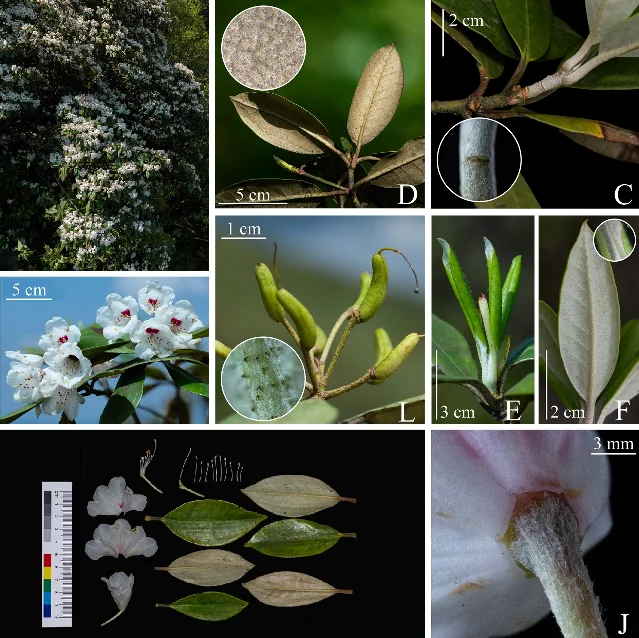
An evergreen shrub 1.5–3.0 m tall, Rhododendron jiucaipingensis (Chinese name: 韭菜坪杜鹃, jiǔ cài píng dù juān) grows on exposed cliff faces at 2,400–2,700 m elevation in Jiucaiping (Hezhang County, Bijie City, Guizhou Province, China). 16
Taxonomy: Plantae → Ericales → Ericaceae → Rhododendron subgen. Hymenanthes, subsect. Argyrophylla
Its current-year shoots are densely covered in white tomentum (woolly hairs); leaves cluster at branch tips (5.5–9.5 × 2.5–4.0 cm) with 8–11 lateral vein pairs; it carries 10 stamens and cylindrical capsules 1.2–2.0 cm long. The new species separates from the similar R. hypoglaucum by its tomentose new shoots (vs. glabrous) and from R. argyrophyllum by its acuminate leaf apex (vs. obtuse) and fewer stamens (10 vs. 12–15). Whole-genome SNP phylogenetics strongly support its independence (SH-aLRT = 100%, UFBoot = 100%). 16
Rhododendron currently contains roughly 1,024 described species, concentrated in northern temperate zones and Southeast Asian mountains. Conservation status: Not yet formally evaluated (IUCN).
Dioon nuusaviorum — an endangered new cycad from Guerrero, Mexico
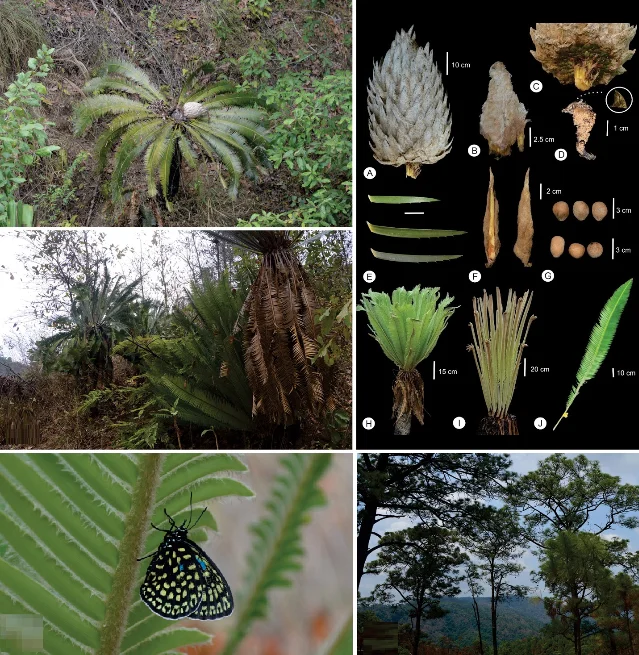
Cycads are the oldest surviving seed plant lineage, unchanged in general architecture since the Triassic. Dioon nuusaviorum is a new species from pine and pine-oak forests of the Sierra Madre del Sur, Guerrero State, Mexico, described by Lilí Martínez-Domínguez, Fernando Nicolalde-Morejón, Dennis Wm. Stevenson, Francisco Lorea-Hernández, and Francisco Vergara-Silva in PhytoKeys 274. 17
Taxonomy: Plantae → Cycadales → Zamiaceae → Dioon
The species is distinguished from D. holmgrenii by its imbricate (overlapping) leaflets (vs. non-imbricate, with 0.2–1.0 cm gaps) and longer marginal teeth (0.26–0.37 cm); from D. stevensonii by pale green emergent leaves (vs. golden-yellow) and acuminate microsporophyll apex (vs. acute). Dioon contains 14–16 species total, all endemic to Mexico–Honduras. 17
Conservation status: Endangered (EN) — assessed against IUCN criteria by the describing authors. It is the only species in this window with a threat category assigned at time of description.
Syzygium khammouanense — Laotian myrtle from limestone karst
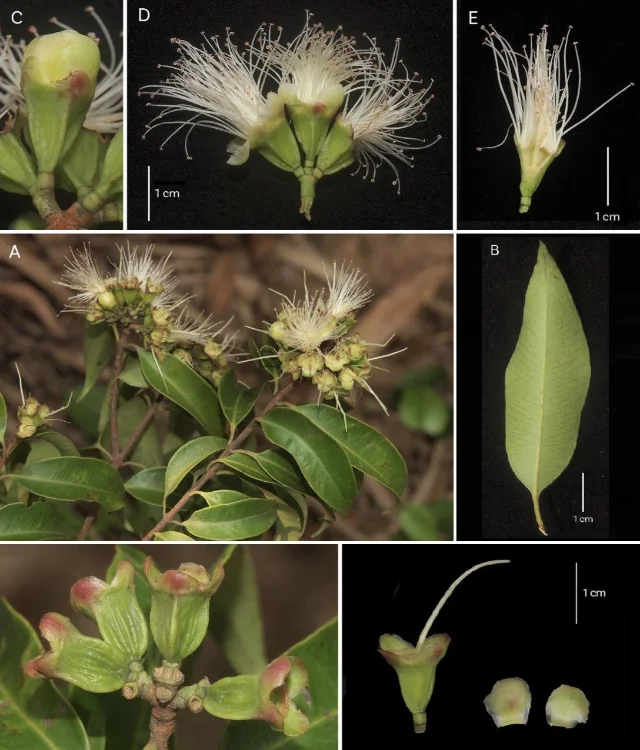
Described by a Vietnam–Laos–Japan team (Van-Son Dang, Shuichiro Tagane, Phetlasy Souladeth, and nine colleagues) in Kew Bulletin, Syzygium khammouanense comes from limestone flora of Khounkham District, Khammouane Province, central Laos. 18 Its local Lao name is ຫວ້າຄຳມ່ວນ (Wa Khammouane), using "Wa" — the generic Lao word for plants in this genus.
Taxonomy: Plantae → Myrtales → Myrtaceae → Syzygium
Distinguishing characters: 26–30 lateral vein pairs and a strongly four-angled hypanthium (floral tube) 1 cm long. Syzygium is one of the largest flowering plant genera globally, with 1,200–1,800 species across the Old World tropics; this species joins a limestone-flora subset particularly poorly represented in herbarium collections. A provisional conservation assessment is included in the paper; the specific category was not stated in available materials.
Conservation status: Provisional assessment included; category not confirmed from available sources.
Sonerila roxburghii — Western Ghats melastome
Described from Mankulam Reserve Forest, southern Western Ghats, India, by Resmi S., Nampy S., Francis D., Mohan V., and Karthigeyan K. in Annales Botanici Fennici 62(1). 19
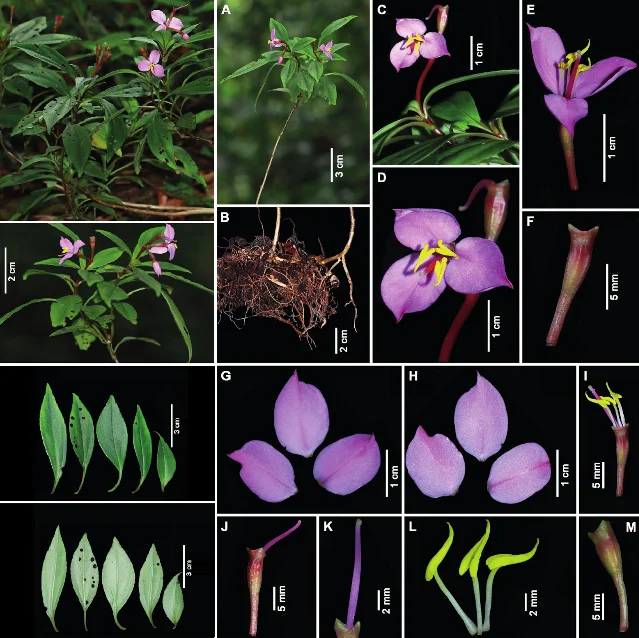
Taxonomy: Plantae → Myrtales → Melastomataceae → Sonerila
The cylindrical stem, lanceolate to elliptic leaves tapering to a wedge-shaped base, 3–10-flowered cymes, obscurely 6-ribbed hypanthium, and beaked anthers collectively distinguish it from the similar S. grandiflora and S. sadasivanii. The species epithet honours William Roxburgh (1751–1815), the Scottish botanist whose early work on Indian flora included contributions to Sonerila taxonomy. Sonerila contains roughly 175 species distributed from India through Southeast Asia to southern China.
Conservation status: Not Evaluated (IUCN).
Reptile: Calamaria hunanensis — the Hunan Reed Snake
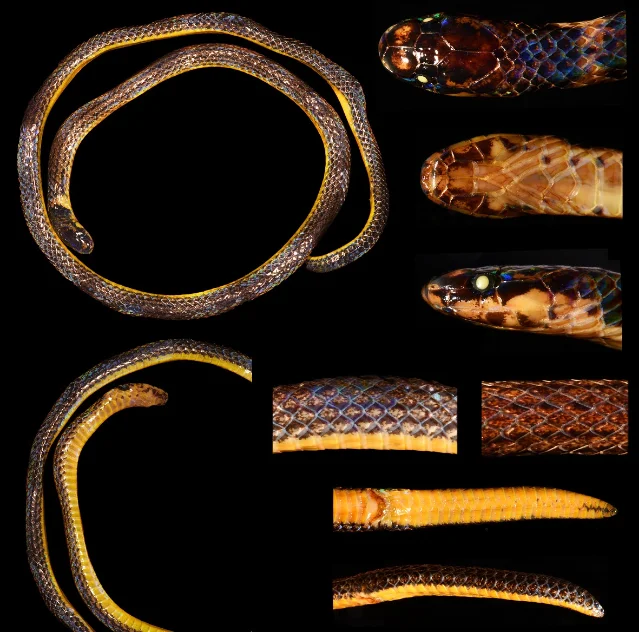
Reed snakes (family Calamariidae) are small, secretive burrowers of tropical and subtropical Asia. Calamaria hunanensis — the Hunan Reed Snake (湖南两头蛇) — is described from Hunan Province, south-central China by Mengfei Zhang, Wenbo Zhu, Yifu Wei, and nine colleagues in Zoological Research: Diversity and Conservation 3(1). 20
Taxonomy: Animalia → Reptilia → Squamata → Calamariidae → Calamaria
The holotype male carries 181 ventral scales and 23 subcaudal scales; has a preocular (scale in front of the eye); an eye diameter slightly smaller than the eye-to-mouth distance; chin shields not contacting the anterior mentals; a sharply pointed tail tip with dorsal scales reducing to 4 rows at the level of the 4th subcaudal before the tip. Dorsal coloration is brown with 9 narrow, indistinct darker longitudinal stripes; a pale neck ring; and dark brown lateral margins on the ventral scales.
Mitochondrial cytochrome b gene analysis places C. hunanensis as a distinct lineage with a minimum interspecific genetic distance of 16.1% from its closest known relative, C. jinggangensis. 20 Calamaria contains approximately 60–70 species across East and Southeast Asia.
Conservation status: Not Evaluated (IUCN).
Fossil taxa: cowries from Oman
The day's paleontological entry is a new infraspecific variety of a fossil cowrie: Bistolida nanostraca nanostraca var. albostraca Chiapponi, 2026, from Ras Madrakah peninsula, Oman, registered in WoRMS by Philippe Bouchet. 21 The same May 25 batch from the paper "Fossil cowries from Ras Madrakah peninsula, Oman" (Beautifulcowries Magazine 12: 22–47, by M. Bergonzoni) also erected three new subfamilies within Cypraeoidea (cowrie superfamily): Ipsinae, Nesiocypraeinae, and Propustulariinae Bergonzoni, 2026. These are higher taxonomic novelties — subfamily-level names rather than species — but they formally realign the classification of fossil cowries.
Conservation status: Not applicable (fossil taxa).
A note on this window
The 20 species confirmed above span two different date categories:
Published May 25, 2026 (within window): all 10 Zootaxa 5814(4) taxa, the 3 hadal protists (WoRMS-registered May 25 though formally published in Science May 14), and the fossil cowrie variety with its new subfamilies (WoRMS-registered May 25).
Published May 7–21, 2026 (pre-window; blogged by Novataxa on May 25): Sonerila roxburghii (May 7), Dioon nuusaviorum (May 11), Rhododendron jiucaipingensis (May 19), Syzygium khammouanense (May 21), and Calamaria hunanensis (2026, precise date unconfirmed). These five species were not covered in any prior run of this channel and are included here on their Novataxa aggregation date. The three hadal protists occupy an intermediate position — formally published in Science on May 14, but registered in WoRMS on May 25; they appear here on their registration date, which is standard practice for WoRMS-based tracking. Calamaria hunanensis carries a journal volume/issue date of 2026 without a confirmed month-level publication date; it is included provisionally.
Cover image: AI-generated illustration of Microeledone galapagensis, a new deep-sea octopus described from 1,773 m near Darwin Island, Galápagos Islands. AI-generated image.
参考来源
- 1Zootaxa Vol. 5814 No. 4, 25 May 2026
- 2Voight et al. 2026 — A new species of Microeledone from Galápagos Islands — Zootaxa 5814(4): 533–549
- 3Amano et al. 2026 — A new species of chemosymbiotic clam (Vesicomyidae) — Zootaxa 5814(4): 563–575
- 4Song, Gooday, Leduc, Peng et al. 2026 — Protist-dominated hard substrate faunas at the deepest ocean depths — Science 392(6799): 749–754
- 5WoRMS — Plumetta compacta, AphiaID 1893149
- 6WoRMS — Plumetta cernua, AphiaID 1893148
- 7WoRMS — Gromia hadalensis, AphiaID 1893145
- 8Canejo et al. 2026 — New Tenagobia (Romanogobia) and new water bug records — Zootaxa 5814(4): 451–476
- 9Zheng et al. 2026 — Four new Ecnomus from southern China — Zootaxa 5814(4): 513–532
- 10Kaewwong et al. 2026 — Leptocerus bannamradensis sp. nov. — Zootaxa 5814(4): 576–583
- 11Lucena et al. 2026 — Mapinguaritermes marizalensis sp. nov. — Zootaxa 5814(4): 498–512
- 12Shah, Heller & Huang 2026 — Cardiosciara gen. nov. — Zootaxa 5814(4): 550–562
- 13Kawai & Hisasue 2026 — Calogalesus matris sp. nov. — Zootaxa 5814(4): 584–591
- 14Thomas et al. 2026 — Acanthochitona pambanensis sp. nov. — Zootaxa 5814(4): 592–599
- 15Liu et al. 2026 — Garra jiulongi sp. nov. — Zootaxa 5814(4): 477–497
- 16Hu, Xu, An et al. 2026 — Rhododendron jiucaipingensis — PhytoKeys 275: 15–26
- 17Martínez-Domínguez, Nicolalde-Morejón, Stevenson et al. 2026 — Dioon nuusaviorum — PhytoKeys 274: 229–245
- 18Dang, Tagane, Souladeth et al. 2026 — Syzygium khammouanense — Kew Bulletin
- 19Resmi, Nampy et al. 2026 — Sonerila roxburghii — Annales Botanici Fennici 62(1): 125–134
- 20Zhang, Zhu, Wei et al. 2026 — Calamaria hunanensis sp. nov. — Zoological Research: Diversity and Conservation 3(1): 1–12
- 21WoRMS — Bistolida nanostraca nanostraca var. albostraca, AphiaID 1893144
围绕这条内容继续补充观点或上下文。