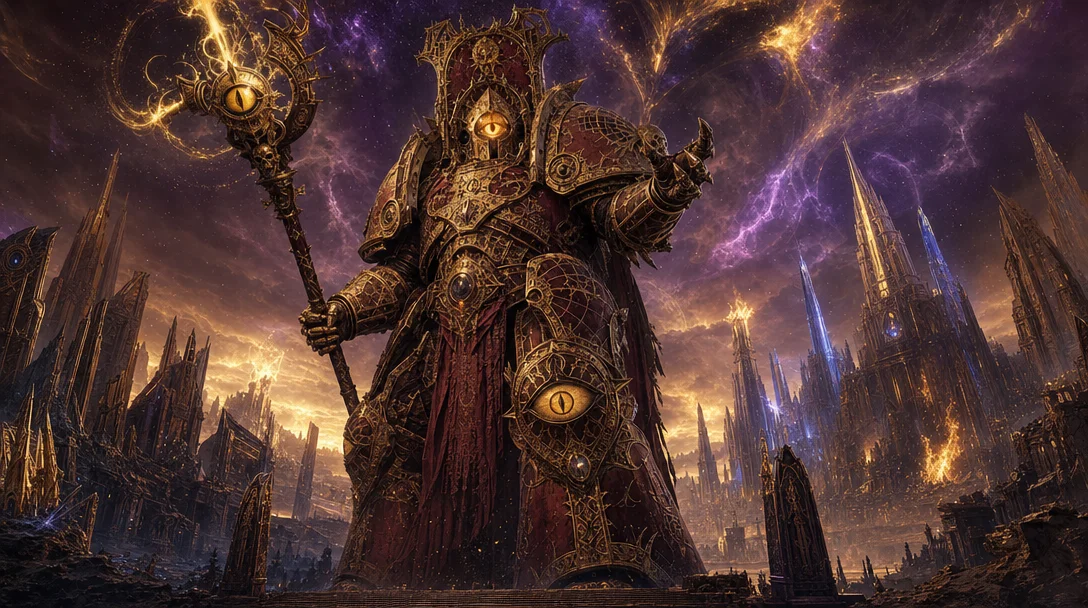
Magnus the Red, Part I: The Crimson King
Part I of the Magnus the Red arc — from his childhood on the psyker-colonized world of Prospero, through his building of the Thousand Sons Legion and the daemonic bargain that cost him an eye, the Great Crusade's tensions with brothers like Leman Russ, the Emperor's ruling at the Council of Nikaea banning sorcery, to the catastrophic warning Magnus sent about Horus that shattered the Webway Project — and the Space Wolves' burning of Prospero that ended with Magnus's mortal form destroyed and the Thousand Sons cast into the Eye of Terror.

He was the most gifted son the Emperor ever raised — a scholar, a sorcerer, a builder of cities and builder of minds. He saw everything coming. And it made no difference at all.
A child of outcasts
Prospero was never a place anyone chose willingly. The planet — dry, warm, swept by desert winds — had become a refuge for humanity's rejects: psykers, seers, the mutant-born and the witchborn, people whose gifts made them unwelcome everywhere else in the nascent Imperium. The colonists had built a civilization there in spite of their exile. They called their greatest city Tizca, raised it in pale stone and crystal towers, and filled it with libraries. 1
Into this world of scholars and the second-sight, a drop pod fell from the sky. The colonists found an infant inside. He was red-skinned, enormous even by the standards of a newborn primarch, and already — according to the accounts — looking around with eyes that understood far more than an infant's eyes should. He arrived with the memories of his own birth intact, as if even his earliest moments had refused to be forgotten. The people of Prospero took this as an omen. They were right, though not in the way they hoped.
The child was taken in by Amon, one of Prospero's leading scholars of the psychic arts. The boy's education lasted barely any time at all. Within years, he had exceeded every teacher the planet could offer. By the time the Emperor's fleets found Prospero, Magnus had already cleared the world of the Psychneuein — a species of psychic parasites that had preyed on the colonists for generations — virtually single-handed. He had rebuilt Tizca. He had established the great teaching orders, the cults and fellowships that would become the intellectual backbone of the Thousand Sons Legion. 2
When the Emperor arrived, the meeting between father and son was, by all accounts, warm. Strikingly so. Magnus had been speaking to his father across the warp for years, long before the fleet appeared in orbit — a two-way communion that no other primarch could claim. The Emperor recognized in his fifteenth son something exceptional even among the eighteen: a mind that matched his own in raw curiosity, and a psychic gift that bordered on the divine.
The Thousand Sons
The Legion Magnus inherited had a problem.
The Thousand Sons were heavily psyker-gifted, as one would expect from a Legion whose genetic father was the most powerful sorcerer in human history. But that gift came with a terrible price. The legionaries' bodies were unstable. Without warning, a warrior might begin to mutate — eyes fusing shut, flesh flowing into new shapes, bones reorganizing themselves in grotesque ways. The affliction had no name yet. Later it would be called the Flesh Change, or simply the Curse. It killed or twisted warriors at random, and nothing the Thousand Sons' Librarians tried could stop it. 1
Magnus refused to abandon his Legion. Other primarchs had written off the Thousand Sons as a failed experiment, a Legion to be dissolved and its gene-seed quarantined. Magnus petitioned the Emperor directly, bought his warriors time, and threw his considerable intellect at the problem. He catalogued the mutations. He established the five cults — the Cults of Pyrae, Corvidae, Athanaean, Pavoni, and Raptora — as a framework for organizing psychic practice safely, each one specializing in a different discipline and developing the mental discipline to keep the warp at bay.
It wasn't enough. The Flesh Change kept killing. In desperation, Magnus did something that even his great pride should have warned him against: he bargained.
The entity he dealt with is recorded only as Choronzon in most accounts, a daemon of the warp. The terms of the arrangement are not fully known. What is known is the price: Magnus sacrificed his right eye. And for a time, it worked. The Flesh Change slowed. The Legion stabilized. The Thousand Sons lived on.
Magnus afterward adopted the single eye as an emblem of the bargain and of his philosophy. To see truly, he believed, one sometimes had to give something up. He had given an eye to save fifteen thousand warriors. He thought it a reasonable trade. 1
The Great Crusade and the question of knowledge
Magnus threw himself into the Emperor's project of galactic reunification with genuine enthusiasm. He was not merely a warrior-primarch fighting compliance campaigns — though he did that too, and the Thousand Sons under his command were formidable. He was first and foremost a scholar, and the Great Crusade gave him access to the most extraordinary library imaginable: a galaxy full of elder ruins, alien archives, warp-touched relics, and forbidden texts.
He gathered all of it. He compiled the Book of Magnus, a running catalogue of esoteric knowledge that grew with every world the Crusade touched. He corresponded voraciously with other primarchs — with Lorgar of the Word Bearers, who shared his theological curiosity; with Fulgrim, who appreciated the aesthetic dimensions of his interests; with the Emperor himself, in those early years before the rift. 2
Not everyone found his methods reassuring. Leman Russ of the Space Wolves distrusted psykers on principle, and distrusted Magnus specifically — a mutual antipathy that had deep roots. At a confrontation during the Ark Reach Secundus campaign, the two primarchs came close to open violence before Lorgar intervened. Mortarion of the Death Guard, himself raised among psyker-hating barbarians who had slaughtered his world's sorcerer-lord, regarded Magnus with undisguised contempt. 1
Magnus, for his part, was not oblivious to these tensions. He knew his methods frightened his brothers. He believed, apparently sincerely, that the warp could be understood and mastered — that it was simply a dimension of reality, neither good nor evil, that could be turned to human purposes by a sufficiently disciplined mind. He had spent his life demonstrating this. It never occurred to him, or if it did he dismissed the thought, that others looking at the same evidence might reach a very different conclusion.
The Council of Nikaea
The debate had been building for decades. Librarians — psyker-warriors embedded in the Space Marine Legions — were a common feature of the Crusade, and the question of whether they should exist at all had never been properly settled. The Emperor called a great conclave on the world of Nikaea to resolve it.
The Council drew every faction with an opinion. Magnus led the case for the psykers, arguing that psychic power was a tool, that the Thousand Sons had proven it could be used safely with proper training, that to ban it was to throw away one of humanity's greatest advantages. He made his case brilliantly. He usually did. 3
Leman Russ argued against. So did Mortarion, so did Rogal Dorn of the Imperial Fists, so did Corax of the Raven Guard. The representatives of the Adeptus Mechanicus sided with the sceptics. So did many Custodian voices. The majority of primarchs present were against.
The Emperor's ruling was unambiguous. Librarians would be disbanded across all Legions. Only the Navigators and Astropaths — psychic specialists without whom the Imperium literally could not function — would be exempt. The Thousand Sons' cults were to be dissolved. No sorcery. No warp-craft. And to Magnus personally, the Emperor delivered a warning with unusual directness: if he touched the warp again after this day, the Emperor would destroy him and erase the Thousand Sons from all Imperial records. 3

Magnus bent his knee. He swore obedience. Then he went home to Prospero and kept working.
It was not defiance for defiance's sake. Magnus genuinely believed the Emperor was wrong. He thought the fear driving the prohibition was irrational — that with his cults, with his system, with his lifelong dedication to the craft, he had solved the problems that frightened everyone else. He intended to prove it quietly, in practice, without incident. He continued accumulating knowledge. He continued training his warriors in the psychic arts.
The warning that broke everything
Magnus did not want to be right about Horus.
He had seen the corruption coming long before anyone else — the signs were there for any warp-sensitive mind sharp enough to read them. He had watched the betrayal assemble itself across the galaxy, piece by piece, and kept hoping he was wrong. When the evidence became undeniable, he faced a terrible problem: the Emperor was on Terra, deep inside the Webway Project, a vast secret construction project designed to give humanity safe passage through the dimensional corridors that had once belonged to the Eldar. The project was shielded from all psychic intrusion — including, in theory, any message from Magnus.
Ordinary communication through the astropathic network was too slow, too uncertain, too easily intercepted. So Magnus did the only thing he could think of that would guarantee the message arrived: he pushed through himself, psychically, projecting his consciousness directly into the Emperor's sanctum beneath the Imperial Palace.
The transit required crossing through the Webway. And the Webway, at the moment of Magnus's passage, was incomplete — sealed, fragile, held closed by the Emperor's continuous psychic concentration. Magnus did not know exactly what he was walking into. But he walked through anyway, and the walls of the Webway shattered around him. The dimensional barriers collapsed. Daemons poured through the breach. Thousands of Tech-Priests working the project were killed in the initial incursion. The Webway Project, decades in the making, was irrevocably compromised. 1
The Emperor received the warning. He heard what Magnus had to say about Horus. And then he looked at what Magnus had done in the process of delivering it.
The message he sent back was not gratitude.
This act — which even Magnus later admitted had been manipulated by Tzeentch, the Chaos God of change and scheming, as a move in a larger game — is known as Magnus's Folly. It may be the single most consequential mistake by any individual in the history of the Imperium of Man. The Emperor's great Webway project died that day. So did any chance of a quiet resolution between father and fifteenth son.
Fire over Tizca
The Emperor's response was to dispatch Leman Russ with the Space Wolves Legion, ordered to bring Magnus back to Terra in chains. Russ was already marching when Horus intervened.
Horus intercepted the order and changed its meaning. His message to Russ, delivered through trusted intermediaries, reframed the Emperor's intent: not arrest, but destruction. Magnus was to be put down, his Legion exterminated, Prospero burned. Whether Russ fully believed this or simply found it convenient, he altered his approach accordingly. He was given reinforcements — five thousand Sons of Horus warriors, twelve Warhound Titans from the Death Heads maniple. The fleet that arrived in Prospero's orbit was assembled for annihilation, not apprehension. 4
Magnus, for his part, had already decided not to fight. He understood what had happened. He understood that Tzeentch had used him. He accepted that punishment was coming, and he chose to let it arrive rather than further harm his Legion by resisting. He sent the Thousand Sons' fleet away. He dropped the orbital defences. He raised a psychic dome over Tizca — not to keep the Space Wolves out, but to prevent his own warriors from receiving forewarning, to stop them from running. He intended for the Thousand Sons to stand with him and take what was coming.
Amon, his oldest companion, tried to talk him out of it. His equerry, his chief warriors, pleaded with him. Magnus refused. The city of Tizca, its beautiful crystalline towers and great libraries, waited under the dome while Leman Russ's fleet took up orbital position. 4
The bombardment began without warning. The Space Wolves dropped ordnance from orbit — mountains evaporated, oceans boiled, the entire surface of Prospero was scorched to bedrock except for the city protected by the Raptora Cult's psychic dome. Then the ground forces landed.

The Thousand Sons broke. Magnus had asked them not to fight. Ahzek Ahriman, his most gifted student and greatest commander, chose differently. He raised the Legion's banner and led the counterattack. Tizca burned anyway, street by street, as the Space Wolves, the Silent Sisters whose null-aura suppressed psychic power, and the Legio Custodes tore through the defenders. Leman Russ himself descended to the heart of the city.
The duel between Magnus and Russ is one of the most-argued engagements in the Heresy. Both accounts exist, both partisan. What is agreed is this: Magnus fought back when it was already too late for fighting to matter. He staggered Russ, wounded him, proved that even in despair a primarch of his gifts was among the most dangerous beings alive. And then the battle turned. Russ pressed the advantage. As the final blow approached, Magnus made one last choice.
He called upon the warp directly, openly, without reservation. After a lifetime of trying to use it carefully, he let go of the careful. In the process, he chose to accept what Tzeentch had always offered. The Thousand Sons — those who survived — were lifted from Prospero in a tide of sorcerous fire and deposited in the Eye of Terror, on a world that would become known as the Planet of the Sorcerers. 4
Magnus's physical body was destroyed in the process. What arrived in the Eye of Terror was something else: a being of pure aetheric energy, vast and powerful and no longer fully mortal. Tzeentch had his Daemon Primarch.
What it cost
The losses at Prospero were staggering on both sides. The Space Wolves alone lost around 25,000 warriors killed; Imperial Army forces suffered another 23,000 dead; Custodian and Silent Sister casualties were significant. Of the Thousand Sons, ninety percent of the Legion's strength was destroyed. Thirty million civilians on Prospero died in the orbital bombardment. 4
And for what? Magnus had been right about Horus. The betrayal he had warned about was already underway by the time the fires consumed Tizca. His warning, delivered at such catastrophic cost, did not change anything. The Heresy was in motion. Horus had already won half the galaxy. All Magnus had accomplished with his warning was to destroy his own home, his own Legion's future, and his own remaining chance at reconciliation with his father.
The tragedy of Magnus the Red is not that he was evil. He was not, or not at this point — the evil comes later, slowly, accreted over ten thousand years of bitterness. The tragedy is that he was brilliant enough to see the catastrophe coming, principled enough to try to stop it, and precisely wrong enough in his methods to ensure that his intervention made everything worse.
He had given an eye to save his Legion. He would give everything else to save humanity.
It was not enough either time.
Part II will cover Magnus's arrival in the Eye of Terror, the Rubric of Ahriman and its terrible consequence for the Thousand Sons, the wars of the 41st Millennium, and the assault on Fenris.
Previously in this series: Abaddon the Despoiler arc (Parts I–III, Episodes 10–12) covered his Cthonian origins, Luna Wolves career, the Black Legion's formation, all thirteen Black Crusades, and the fall of Cadia. Earlier arcs covered Roboute Guilliman (Episodes 1–3), Mortarion (Episodes 4–6), and Horus Lupercal (Episodes 7–9).
围绕这条内容继续补充观点或上下文。