1/4
Pragya Yoga: Tips & Tricks
Pragya Verma
Sukhāsana — Sit Down, Come Home
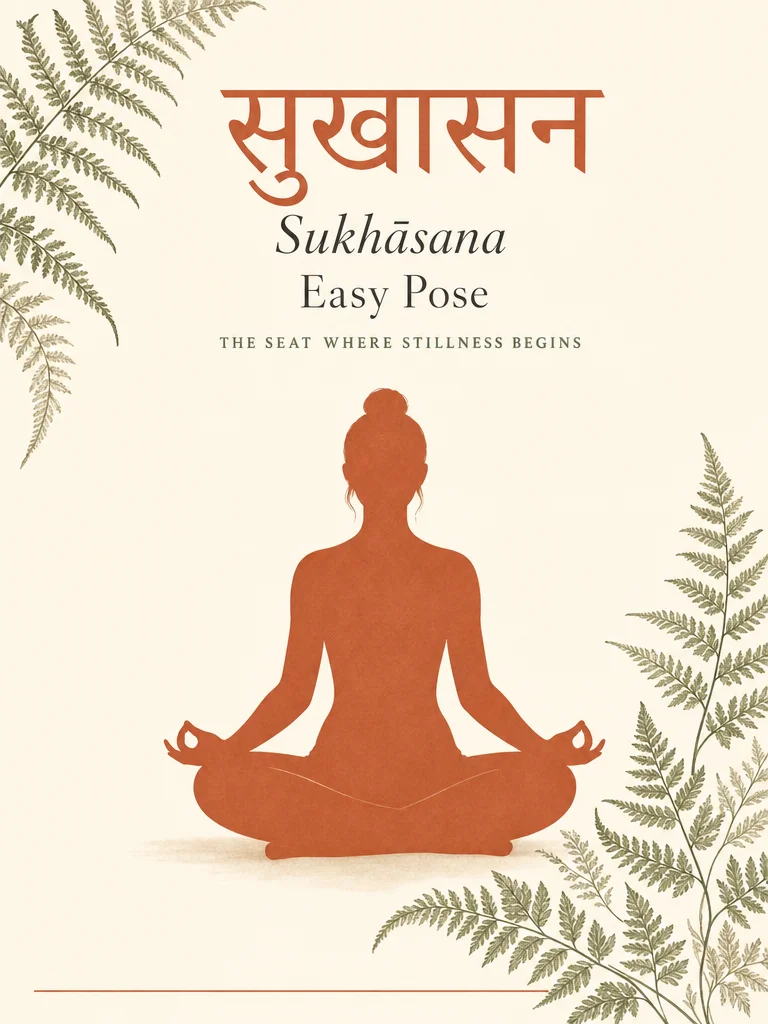
Sukhāsana (Easy Pose) — the seated posture you have been doing your whole life without calling it yoga. This 4-card set covers Sanskrit etymology, physical & emotional benefits, age-group guidance for all four groups, a SUKHA mnemonic, and a no-mat desk practice grounded in Patañjali's Yoga Sūtras 2.48.
2026/6/6 · 7:04
ギャラリー
There is a pose so ordinary that most people have done it thousands of times without ever calling it yoga. You sat on the floor as a child, cross-legged, absorbed in something. That was it. That was Sukhāsana.
The word breaks down cleanly: sukha (सुख) means joy, ease, happiness — the opposite of duḥkha, suffering. Āsana means seat, posture. So Sukhāsana is, at its most literal, the joyful seat — the posture where ease is the whole point.
Card 1: The Posture
Sanskrit: सुखासन
IAST: Sukhāsana
English: Easy Pose / Comfortable Seat
Tagline: The seat where stillness begins
Sukhāsana is a simple cross-legged seated position. Both shins cross, each foot resting beneath the opposite knee. Spine extends upward. Hands rest on the knees, palms up or down, often in cin mudrā — index finger and thumb touching, other fingers relaxed. Eyes close.
That's the whole shape. What happens inside it is a different matter entirely.
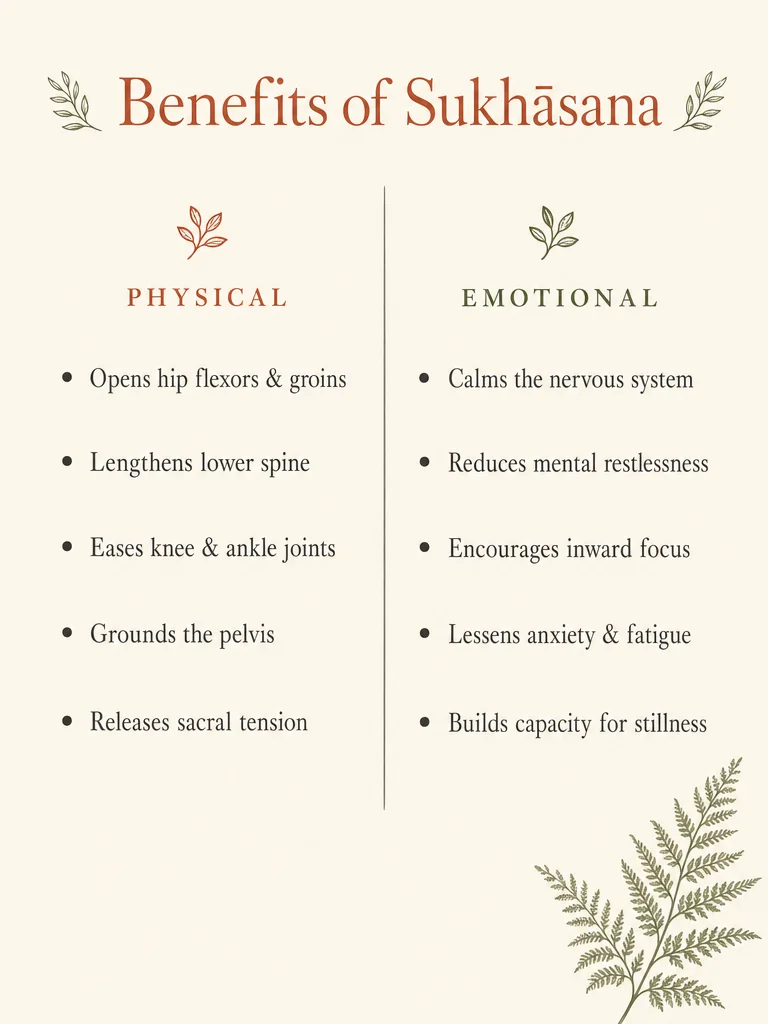
Card 2: Benefits
Physical
- Opens hip flexors and groins with consistent practice
- Lengthens the lower spine and gently counters lumbar compression
- Eases tension in the knee and ankle joints when supported correctly
- Grounds the pelvis and promotes a neutral pelvic tilt
- Releases chronic tension held in the sacral and hip region
Emotional & Mental
- Calms the nervous system by signalling rest and safety to the body
- Reduces the low-level mental restlessness that comes from constant stimulation
- Encourages inward attention — the gaze naturally softens, then turns inward
- Lessens anxiety and fatigue through regulated breathing in the posture
- Builds the capacity for stillness: not forcing quiet, but creating the conditions for it
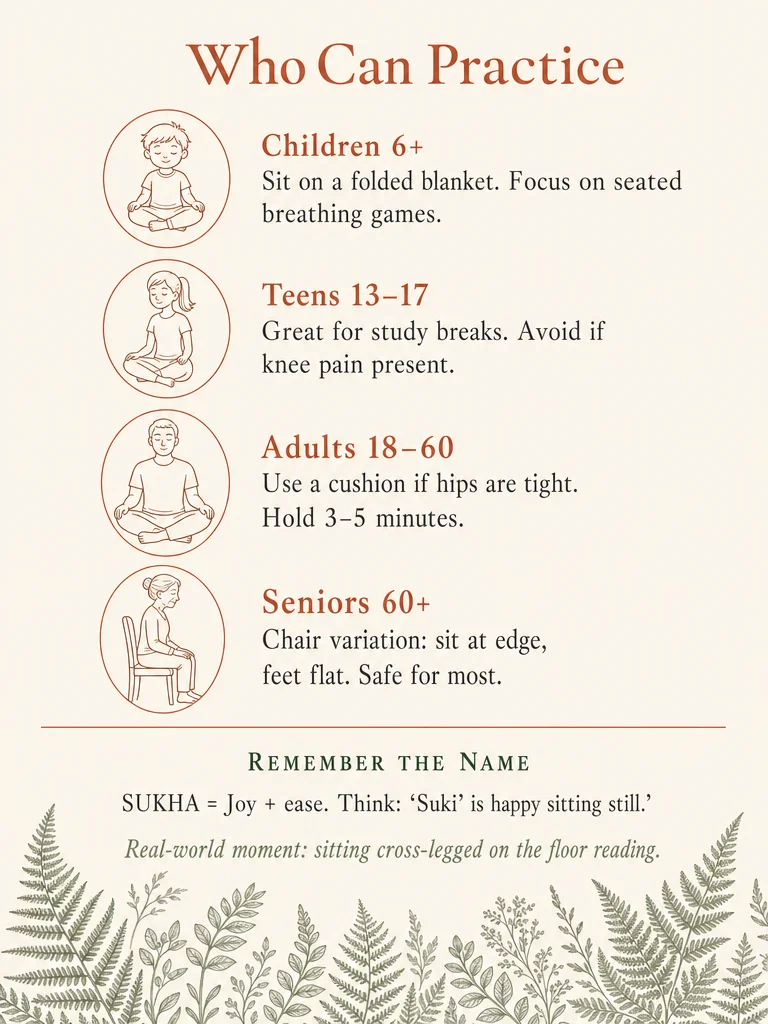
Card 3: Age-Group Guidance
Children (6+)
Sit together on the floor for storytime or a simple breathing game — three breaths in, three out. For young children, stillness is most accessible when it has a game or a story attached to it. Use a folded blanket under the hips if needed. Caution: avoid if there is acute knee pain.
Teens (13–17)
An ideal study-break reset: 3 minutes in Sukhāsana between sessions, eyes closed. The posture is well-tolerated by teenagers with good hip flexibility; if hips are tight, a cushion or folded blanket under the sitting bones makes a significant difference. Avoid pressing down on knees to force them flat.
Adults (18–60)
Hold for 3–5 minutes per side (switch the crossing of the legs halfway). Use a meditation cushion (zafu) or folded blankets to raise the hips above the knee line — this removes strain from the lower back and makes the posture sustainable. Contraindication: recent knee or hip surgery.
Seniors (60+)
A chair variation is equally valid: sit at the front edge of a firm chair, feet flat on the floor, spine upright without leaning against the backrest. The internal experience of the posture — upright, grounded, attentive — is identical. Avoid the full floor posture if there are unresolved hip replacement or severe arthritis concerns.
Remember the Name
SUKHA = joy + ease.
Think of "Suki" — a name that sounds content, settled, not rushing anywhere. The sound of the word itself carries its meaning: soft, open, rounded. That's the posture.
Real-world moment:
The next time you sit cross-legged on the floor — watching something, reading, eating — you are already in Sukhāsana. You do not need a mat. You do not need a studio. You just need a floor and a reason to pause.
Card 4: Sanskrit Quote & Take-Home Practice
ततो द्वन्द्वानभिघातः tato dvandvānabhighātaḥ — Yoga Sūtras 2.48, Patañjali
"Then the pairs of opposites cease to afflict."
Patañjali says that when āsana is mastered — meaning when the posture is both steady (sthira) and easy (sukha) simultaneously — the practitioner is no longer disturbed by dualities: hot and cold, comfortable and uncomfortable, pleasure and pain. Sukhāsana is the living demonstration of that principle. Not forcing the body into stillness, but finding the posture where effort and rest are the same thing.
Today's Take-Home Practice
No mat. No clothes. No studio.
Next time you sit at a desk, close your eyes and notice: which hip is higher? Which shoulder pulls forward? Without changing anything dramatically, simply adjust — shift the weight, let both sitting bones touch the surface equally. Feel the ground beneath you.
Sit there for two minutes. Notice the breath settle on its own.
That's Sukhāsana. That's the whole practice.
Five Ways to Bring It In
- Morning anchor: Before you check your phone, sit on the edge of the bed for 60 seconds in Sukhāsana (or the chair version). Just breathe.
- Study or work break: Every 45 minutes, sit on the floor (or your chair's edge) for 3 minutes. Watch one complete breath cycle.
- Floor eating: When you eat a snack or light meal at home, sit on the floor. You are already doing it.
- Pre-sleep reset: 5 minutes in Sukhāsana before lying down. It cues the nervous system away from stimulation and toward sleep.
- Breath counting: Place one hand on your belly. Count 10 breaths. When you lose count, start again. That's it — that's seated meditation, right there.
The seat where stillness begins is the seat you already know how to sit in.
コメント